
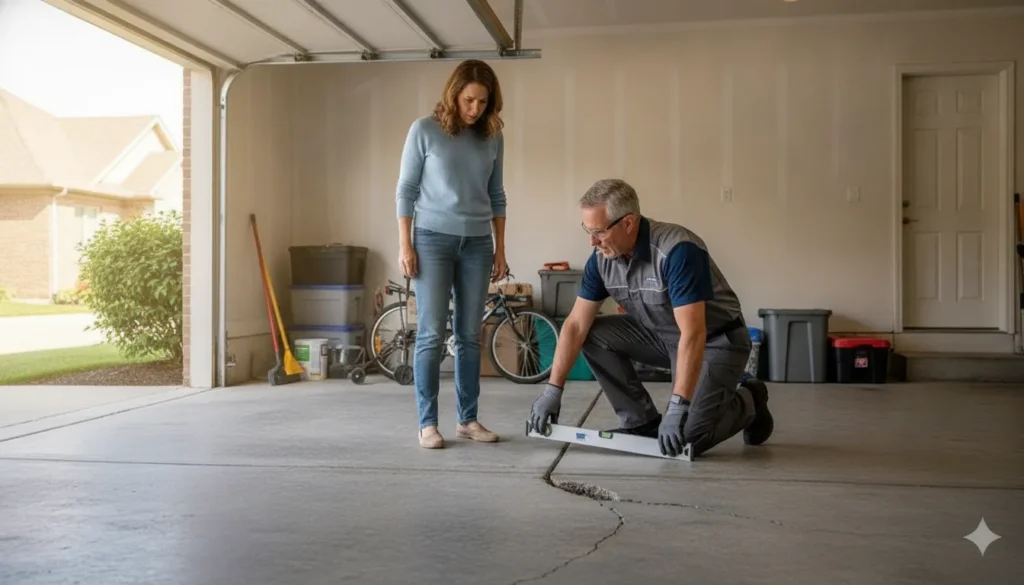
A sunken garage slab can make parking awkward, leave gaps beneath the concrete, and create a trip hazard at the entry. In North Texas, the cause often starts below the surface: expansive clay swells when wet. Then shrinks as it dries, which can leave voids and uneven support beneath a slab.
Garage floor leveling can restore a settled slab when the concrete remains suitable for lifting and the problem comes from voids beneath it. If the slab is badly broken or the movement reflects broader foundation settlement, a professional inspection can determine whether repair, replacement, or structural stabilization is the sounder path.
The right solution depends on the condition of the concrete, the size of the settled area, and how the surrounding soil has moved. Understanding why North Texas slabs crack and settle helps you recognize the difference between a localized garage problem and a deeper structural concern.
Schedule a free garage floor leveling inspection in North Texas. Call (940) 365-4221 for your free estimate.
Why Garage Floors Settle and Crack in North Texas
A cracked or uneven garage floor can feel like a minor concrete problem, especially when the rest of your home appears stable. In North Texas, however, the soil beneath the slab often explains why the damage develops. Much of the Dallas-Fort Worth region sits on expansive clay associated with the blackland prairie. This soil responds dramatically to changes in moisture, placing repeated stress on the concrete above it.
Expansive clay contains smectite, a mineral made of microscopic, plate-like particles that absorb water. During wet weather, those particles swell and push upward against the garage slab. During dry periods, the clay loses moisture and shrinks. That movement can leave voids beneath portions of the slab, so the concrete no longer has consistent support across its entire surface. You can read more about how expansive clay soil affects Texas foundations and other concrete structures.
The scale of that movement helps explain why recurring cracks should not be dismissed as ordinary wear. One Texas soil source reports that clay can expand by 10 percent or more vertically during a year, while the repeated swell-shrink cycle contributes to long-term slab failure. Those figures do not predict the condition of every property, because drainage, grading, irrigation, tree roots, slab design, and soil depth also influence performance. They do show why North Texas concrete requires a regional assessment rather than a generic repair assumption. Learn more about expansive clay movement and slab support.
Garage floors rarely settle as one perfectly uniform surface. One area may remain supported while another drops into a moisture-created void. This uneven movement is called differential settlement. It can produce a step or slope across the garage, cracks that widen over time, gaps along the slab edge, or separation around the driveway transition. Heavy vehicles and stored equipment can make the uneven surface more noticeable, but they are not necessarily the original cause.
Garage floor leveling addresses the slab’s position and support, while structural foundation repair addresses movement affecting the home’s foundation system. The two concerns can overlap, so the right response depends on what an inspection finds beneath and around the garage. If settlement or visible voids are developing, prompt evaluation can help clarify whether the slab requires leveling alone or whether broader stabilization should be considered.
What Are the Signs Your Garage Floor Needs Leveling?
A settled garage slab rarely changes all at once. In North Texas, expansive clay can swell when wet and shrink during dry periods, gradually leaving unsupported areas beneath the concrete. That movement may first appear as a small inconvenience. But the pattern often becomes easier to recognize when you look at the entire garage floor, walls, and door opening together.
Watch for these warning signs:
- Visible low spots: A section of slab may sit lower than the surrounding concrete, creating a shallow dip that catches dust, debris, or water.
- Puddling or oil streaks: Water that collects in one area after washing the car, or oil marks that run toward a low point. Can indicate a settled section or a void beneath the slab. Maintenance guidance from the Missouri Department of Transportation identifies oil streaks and shoulder settlement as indicators of voids or settlement. Read more about signs your concrete slab needs leveling.
- Gaps at the edges: Look where the garage slab meets the foundation wall, stem wall, or door frame. A visible gap can mean the slab has pulled away as it settled, rather than remaining supported along its original edge.
- A garage door that drags or fails to seal: When the slab shifts near the threshold, the door may scrape the floor, leave daylight beneath the seal, or stop closing evenly. This can allow rain, pests, and outdoor air into the garage.
- Hairline cracks that widen: A narrow surface crack may reflect ordinary concrete shrinkage. Cracks that widen, branch, drop at one side, or appear alongside a low spot deserve a closer inspection. Surface leveling compounds can improve minor cosmetic irregularities, but they cannot repair deep structural cracks.
- A slope toward the center: A garage floor should direct water toward its intended drainage path. If a level, ball, or water test shows that the slab tips toward the middle, settlement may have changed the original pitch.
These signs do not automatically mean the home’s foundation has sustained structural damage. Garage floor leveling addresses a settled concrete slab, while structural foundation repair addresses movement in the foundation system. The two conditions can occur separately or share the same soil-related cause, so the distinction matters when choosing a repair.
Consider arranging an inspection when settlement or voids first become evident instead of waiting for the crack or low spot to spread. A professional can determine whether the slab remains a candidate for leveling, whether the soil has left a significant void, and whether nearby foundation components show related movement. That assessment helps separate a localized garage repair from a deeper structural concern.
Garage Floor Leveling Options: PolyLevel, Mudjacking, or Replacement
Once a garage slab settles over expansive North Texas clay, the right repair depends on the condition of the concrete. The size of the void beneath it, and how much additional weight the soil can support. A professional assessment can separate a liftable slab from one that has broken beyond practical leveling. The three common paths are polyurethane foam injection, mudjacking, and full slab replacement.
| Option | Injection hole size | Cure time | Best for | Weight added | Longevity |
|---|---|---|---|---|---|
| PolyLevel polyurethane foam | About 5/8 inch | About 15 minutes | Precise lifts, void filling, and lightweight repairs | Lightweight, waterproof foam | Durable when the slab and soil conditions are suitable |
| Mudjacking or slab jacking | Typically 2 inches or larger | Depends on grout mix and site conditions | Residential garages without specific weight sensitivities | Heavier grout mixture | Depends on soil movement, slab condition, and void stability |
| Full slab replacement | None | Depends on concrete curing requirements | Badly cracked, broken, or structurally unsound slabs | New concrete replaces the existing slab | Depends on drainage, soil preparation, and future movement |
Polyurethane foam injection
PolyLevel uses high-density polyurethane injected through small holes to fill voids and raise settled sections with controlled pressure. The material allows precise placement, which helps a technician make incremental adjustments rather than relying on a broad, heavy grout fill. The smaller injection points also reduce surface disruption. Polyurethane cures in about 15 minutes, resists water, and adds little weight to soil that may already be unstable.
Explore polyurethane foam garage floor leveling to see how this approach fits concrete repair work.
Mudjacking and slab jacking
Mudjacking pumps a grout mixture beneath the slab to fill voids and raise the concrete. It remains a practical option for some residential garages, especially where the slab does not have specific weight sensitivities. However, the grout is heavier than polyurethane and the process typically requires injection holes at least 2 inches wide. A technician should evaluate whether the added load makes sense for the supporting soil and whether the slab can tolerate the lift.
Full slab replacement
Leveling methods work best when the existing slab remains sufficiently intact. According to the Missouri Department of Transportation, badly cracked or broken slabs cannot be raised effectively with these techniques. In that situation, replacement may provide a more appropriate path. Removing and repouring the slab also creates an opportunity to address subgrade preparation, drainage, and conditions that contributed to settlement, rather than simply lifting damaged concrete.
For a closer look at the alternatives, review these garage floor leveling methods. A site inspection can identify the repair that matches your slab’s condition, soil support, and intended use.
When Does a Sunken Garage Slab Signal a Deeper Foundation Issue?
A low spot in your garage can be frustrating, especially when water collects near the door or the slab makes everyday storage and parking awkward. Sometimes the problem stays limited to the concrete floor. In other cases, the garage slab is showing the same soil movement affecting the structure of your home.
North Texas expansive clay changes volume as moisture conditions change. That movement can create differential settlement, where one part of a slab or foundation drops more than another. When settlement extends beyond the garage footprint, surface leveling alone may not address the cause. Clay-related differential settlement can require structural stabilization rather than a surface-level remedy.
Red flags that point beyond a cosmetic low spot
- Cracks in the main house foundation: Cracking along the foundation outside the garage suggests the movement may involve the home, not only the garage slab.
- Sticking doors or windows: Interior doors that rub, windows that bind, or trim gaps that appear alongside garage settlement can indicate broader structural movement.
- A gap between the garage slab and the house: Separation at the joint between these areas may show that the slab and foundation are moving differently.
- Extensive stair-step cracks: Stair-step cracking in brick or masonry around the garage or nearby walls deserves professional evaluation, particularly when it grows or appears with other signs.
- Uneven settlement beyond the garage: Sloping floors, separated walkways, or settlement that continues into the driveway or adjoining rooms points to a wider pattern.
Garage floor leveling and structural foundation repair address different problems, although a property may require both. A localized slab with a stable foundation can often be evaluated for lifting, void filling, or another concrete repair approach. A slab that is badly cracked or broken may not raise effectively through leveling techniques, so replacement or a different repair strategy may be more appropriate. Surface leveling compounds can improve a minor finish irregularity, but they cannot repair deep structural cracks or stabilize soil movement.
Pay attention to change over time. A growing crack, widening separation, or new symptom inside the house carries more significance than a fixed shallow depression. Document where the settlement appears and whether it follows periods of heavy rain or dry weather. A qualified inspection can determine whether the issue is confined to the slab or connected to the foundation system, then match the repair plan to the actual cause.
What Does Professional Garage Floor Leveling Look Like?
A settled garage floor can leave you wondering whether the slab requires replacement or whether a less disruptive repair can restore its position. A professional evaluation answers that question before work begins. Because expansive North Texas clay can shrink and swell beneath concrete, the visible dip may reflect a void, uneven soil support, or a broader foundation concern.
Solid Base Foundations starts with a free on-site inspection because an accurate assessment is required for an accurate quote. If PolyLevel fits the slab and soil conditions, the repair can typically proceed with small access points, controlled foam injection, and limited interruption to your garage.
- Inspect the slab and diagnose the settlement. The technician examines the garage floor, cracks, joints, edges, transitions, and nearby foundation areas. The inspection helps distinguish a localized slab problem from movement that may require structural foundation repair. It also gives you a clear recommendation based on the condition of the concrete, not a generic repair formula.
- Identify voids and evaluate soil conditions. The team looks for areas where the slab has lost support and considers how moisture changes may have affected the underlying expansive clay. Shrinking clay can leave voids beneath a slab, while swelling clay can create upward pressure. Understanding the support conditions helps determine where material should go and whether lifting is appropriate.
- Plan the injection points. When high-density polyurethane foam is the right solution, the technician maps out small drilling locations across the affected area. PolyLevel uses injection holes measuring about 5/8 inch, which are substantially smaller than the access points associated with some traditional slab-jacking methods. The placement allows the crew to target voids and control the lift with precision.
- Inject the high-density polyurethane foam. The foam enters the voids beneath the concrete and expands to fill open spaces and raise the settled slab. It is lightweight compared with cementitious fill and does not require a large excavation or a lengthy demolition process. The material expands and cures in about 15 minutes, helping the repair move quickly while limiting disruption to your home.
- Verify the final level. The technician checks the slab throughout the lift and confirms that the garage floor reaches the planned position. This step also identifies any areas that still lack support or require additional injection. The goal is a stable, usable surface that addresses the underlying voids rather than simply covering the visible low spot.
- Complete minimal cleanup and review the repair. The crew fills the small injection holes and clears the work area. You can review the completed repair and discuss practical next steps for protecting the slab from future moisture-related soil movement. For more detail, explore professional PolyLevel garage floor leveling.
This minimally invasive process can restore a settled garage slab without the mess and delay of full concrete removal when the existing slab remains suitable for lifting. A free inspection is the right starting point, since the condition of the concrete and the soil below it determines whether PolyLevel or another repair approach makes sense.
Request a free garage floor leveling estimate in North Texas. A professional can determine whether PolyLevel or another repair fits your slab. Call (940) 365-4221 today.
Frequently Asked Questions
How much does garage floor leveling cost?
The total depends on the slab’s size, the amount of settlement, access, and whether the concrete remains sound enough to lift. A professional inspection can identify the cause and the appropriate repair before anyone recommends a method. Request a free estimate rather than relying on a broad online price range.
Can I do DIY garage floor leveling?
Minor surface imperfections may respond to a suitable leveling product. But that approach does not fill voids beneath a settled slab or address movement in North Texas expansive clay. If the floor has dropped, rocks under vehicle weight, or shows widening cracks, have the slab and surrounding foundation evaluated before applying a topping.
When does a garage floor need leveling versus structural repair?
Leveling addresses a settled or uneven slab when the concrete remains structurally sound. Structural repair becomes the focus when soil movement has caused differential settlement, deep cracks, wall separation, or related foundation movement. Garage floor leveling and foundation repair are distinct services, but one inspection may show that both are necessary.
Will concrete leveling fix major cracks in the garage floor?
Not always. A badly cracked or broken slab may not lift effectively with a leveling method, according to Missouri Department of Transportation guidance: badly cracked slabs may require an alternative repair strategy. Deep structural cracks also require attention to the underlying soil or foundation, not just a surface compound.
Ready to Schedule Your Garage Floor Inspection?
A sunken or cracked garage slab can make everyday use frustrating, especially as North Texas expansive clay soil shifts with changing moisture. An on-site inspection helps clarify whether leveling can restore the slab or whether related foundation concerns deserve attention. Schedule a free garage floor inspection and estimate with Solid Base Foundations. Call (940) 365-4221 or request your free estimate.