
If you live in North Texas, you know our soil has a mind of its own. The expansive clay that lies beneath our homes swells with rain and shrinks in the heat, causing the ground to constantly shift. This movement is the primary reason so many Dallas sidewalks crack, sink, and become uneven. Simply patching the surface won’t solve the underlying problem. To get a lasting fix, you need a solution that accounts for our unique environment. This article explains why our sidewalks fail and what methods provide a stable, long-term sidewalk trip hazard repair Dallas homeowners can count on.
Key Takeaways
- Understand Your Responsibility: As a Dallas homeowner, you are generally responsible for maintaining the sidewalk next to your property. Fixing trip hazards is key to avoiding liability, and the city’s 50/50 cost-sharing program may help with replacement costs.
- Consider Repair Before Replacement: Repairing your sidewalk is typically faster, more affordable, and less disruptive than a full replacement. Modern solutions like poly-leveling provide a long-lasting fix by stabilizing the soil underneath the concrete.
- Vet Your Contractor Carefully: When choosing a company, confirm they have local experience, proper insurance, and offer a warranty for their work. Always get a detailed, free estimate in writing to understand the full scope and cost of the project.
What Is a Sidewalk Trip Hazard?
A sidewalk trip hazard is any unevenness in the concrete that could cause someone to stumble and fall. While a few cracks might seem like normal wear and tear, a raised edge of just a quarter of an inch can be enough to create a serious risk for you, your family, and any visitors to your property. Cracked and uneven sidewalks are more than just an eyesore; they are a liability waiting to happen. Understanding what causes these hazards and how to spot them is the first step toward creating a safer environment around your home. In the Dallas area, specific environmental factors make our sidewalks particularly susceptible to these issues.
Why Dallas Sidewalks Become Uneven
If you’ve noticed your sidewalk slabs are shifting, you’re not alone. The ground in North Texas is constantly moving, and our sidewalks often pay the price. The primary culprit is our expansive clay soil, which swells dramatically when it gets wet and shrinks when it dries out. This constant movement puts immense pressure on concrete slabs.
Other common causes include:
- Water Erosion: Poor drainage can wash away the soil supporting the concrete, creating empty spaces or voids underneath.
- Tree Roots: Large, mature trees are beautiful, but their powerful roots can grow under sidewalks, lifting and cracking the concrete slabs.
- Poor Compaction: If the soil wasn’t packed down properly when the sidewalk was first poured, it can settle over time, leading to sinking and unevenness.
These issues can lead to significant structural problems that require professional concrete repair.
How to Spot a Trip Hazard on Your Property
It’s a good idea to periodically walk your property and inspect your sidewalks and walkways. You don’t need any special tools, just a keen eye for changes. Grab a notepad and check for these common warning signs:
- One concrete slab is visibly higher or lower than the one next to it.
- You can see raised or sunken edges that create a “lip” where a toe could get caught.
- There are large, sprawling cracks in the concrete, which often indicate soil movement underneath.
- Water pools on your walkway after it rains instead of draining away.
- The sidewalk appears to be pulling away from your porch, steps, or driveway.
Seeing these issues on your property is a clear sign that it’s time to consider repairs. You can see examples of how we’ve fixed these exact problems by looking at our work for other Dallas homeowners.
When to Use Warning Signs and Barriers
If you discover a trip hazard on your sidewalk, the most immediate action you can take is to alert others to the danger. This is a crucial temporary step to help prevent an accident while you arrange for a permanent repair. Placing a brightly colored warning sign, a safety cone, or even a temporary barrier like caution tape around the uneven area makes the hazard obvious to pedestrians. This simple act shows you’re aware of the problem and are taking responsible steps to protect others. Once the area is secured, you can contact us for a free, no-obligation estimate to get the problem fixed for good.
Who Is Responsible for Sidewalk Repairs in Dallas?
Figuring out who is on the hook for sidewalk repairs can feel confusing, but it’s a question every Dallas homeowner should have an answer to. Is it your responsibility or the city’s? The answer is often a bit of both. In Dallas, the responsibility for maintaining the public sidewalk adjacent to a private property typically falls on the homeowner. This means if a crack becomes a crater or a tree root creates a ramp, you are likely the one who needs to arrange the fix.
This isn’t just about keeping up appearances; it’s a matter of safety and liability. A neglected trip hazard can lead to injuries, and you could be held responsible. Understanding the local rules, your options, and the programs available can save you a lot of stress and money down the line. Let’s walk through what you need to know about sidewalk responsibility in Dallas.
Homeowner vs. City: Dallas Regulations Explained
In most cases, Dallas homeowners are responsible for maintaining the sidewalks that border their property. While the sidewalk is public right-of-way, city ordinances place the duty of care on the adjacent property owner. This means you are expected to keep it in a safe and passable condition. If someone trips and injures themselves on an uneven section of your sidewalk, you could face legal liability. This is why proactively managing any developing issues is so important. Addressing a small crack or slight lift early on with a professional concrete repair is much easier than dealing with the aftermath of an accident.
Understanding the Dallas 50/50 Cost-Sharing Program
The good news is that you might not have to bear the entire financial burden alone. The City of Dallas offers a cost-sharing initiative to help residents manage the expense of major sidewalk work. The city’s Sidewalk Replacement Program allows eligible homeowners to split the cost of sidewalk removal and replacement 50/50 with the city. This program is available for single-family homes, condominiums, and townhomes. It’s a great option if your sidewalk is beyond a simple repair and needs a complete overhaul. It makes the process more affordable and ensures the work is done to city standards.
Meeting ADA Compliance Standards
When you repair or replace a sidewalk, it’s not just about making it smooth; it’s also about making it accessible. The Americans with Disabilities Act (ADA) has specific standards for walkways to ensure they are safe for everyone, including people who use wheelchairs or have mobility challenges. These standards address issues like the steepness of slopes, the width of the path, and the height of any lips or edges. Fixing trip hazards is a key part of meeting these requirements. A professional repair company will know how to perform the work correctly to ensure your sidewalk is safe, functional, and fully compliant for all members of the community.
The Risks of Ignoring an Uneven Sidewalk
It’s easy to put a sidewalk crack on the back burner, but ignoring it can lead to bigger problems. Cracked and uneven sidewalks are a serious safety risk. A small lift in the concrete can easily catch a toe, leading to a fall and potential injuries for neighbors, mail carriers, or anyone just passing by. As the property owner, you are often responsible for keeping that walkway safe. Failing to do so can open you up to liability claims. Beyond the legal risks, a deteriorating sidewalk can also detract from your home’s curb appeal and value. Seeing how professionals have transformed dangerous walkways in Our Work can show you what a difference a proper repair makes.
Your Sidewalk Trip Hazard Repair Options
When you have an uneven sidewalk, you have several paths you can take to fix it. The right choice depends on how severe the problem is, your budget, and how long you want the solution to last. The options range from quick surface-level fixes to more involved methods that address the root cause of the sinking or heaving concrete.
For very slight unevenness, you might consider a DIY approach or professional grinding. These methods remove a small amount of the concrete surface to even things out. For more significant sinking, you’ll need to look at lifting the concrete slab itself. This is where techniques like mudjacking or poly-leveling come in. These methods inject material underneath the slab to raise it back into place. In cases where the concrete is severely cracked, crumbling, or beyond saving, a full replacement is the only way to go. Understanding each of these options will help you have a more productive conversation with a concrete repair professional and make a confident decision for your property.
DIY Fixes: Grinding, Patching, and Leveling Compounds
For a very minor trip hazard, you might be tempted to handle it yourself. DIY options usually involve grinding down the high edge of the concrete with a power tool or using a patching material or leveling compound to build up the lower side. Products like Fusion-Crete are designed to level uneven concrete and can be a quick fix for small issues.
While this approach can save you money upfront, it’s often a temporary solution. Grinding can create a lot of dust and may not look very clean, while patching compounds can crack or break away over time, especially with Dallas’s shifting soils. These fixes are best for extremely small height differences and may not be a durable, long-term answer for a true trip hazard.
Professional Concrete Grinding
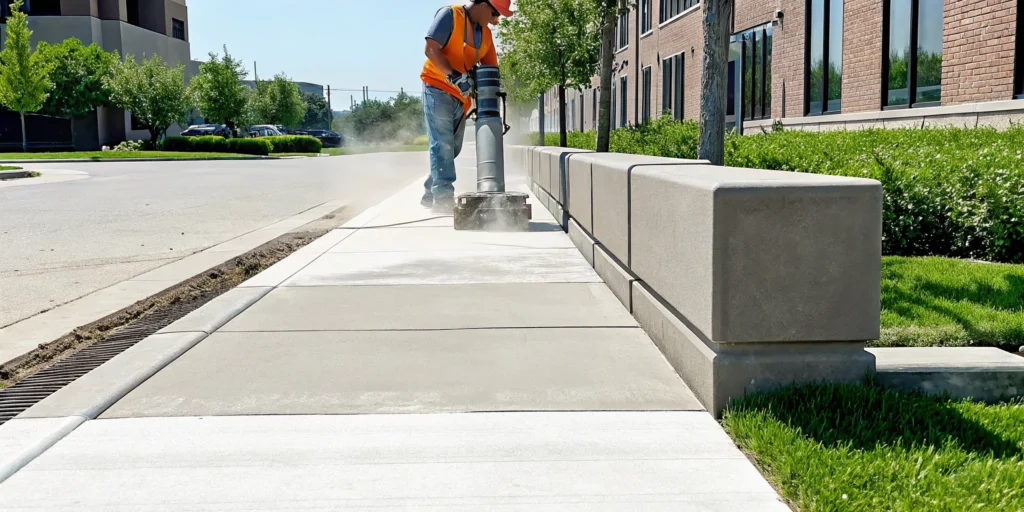
If the edge of your sidewalk panel is raised but the slab itself is still stable, professional concrete grinding can be a great solution. This method uses specialized equipment to precisely and efficiently shave down the higher concrete slab until it’s flush with the lower one. It’s a much more controlled and effective process than trying to do it yourself with a handheld grinder.
Concrete grinding is a targeted fix that corrects the trip hazard without disturbing the rest of the slab. It’s a quick and often cost-effective repair for raised edges caused by tree roots or slight soil heaving. However, it only works when you’re removing material, not for lifting a sunken slab. It’s a specific tool for a specific problem, but when it fits, it works well.
Mudjacking (Slabjacking)
Mudjacking, also known as slabjacking, is a traditional method for lifting sunken concrete. The process involves drilling holes into the sunken slab and pumping a slurry, typically a mixture of mud, sand, and cement, underneath it. The pressure of this material forces the concrete slab to rise back to its original level. Once the slab is level, the holes are patched with cement.
This technique has been used for decades to fix everything from sidewalks to driveways. While it can be effective, the material used is very heavy, which can sometimes add to future soil compression and settling. The drilled holes are also larger than those required for more modern methods. Understanding what mudjacking is can help you compare it to newer alternatives.
Poly-Leveling (Polyurethane Foam Injection)
Poly-leveling is the modern evolution of mudjacking. Instead of a heavy slurry, this method uses a high-density, structural-grade polyurethane foam to lift the concrete. The process is similar: small, dime-sized holes are drilled into the slab, and the two-part foam is injected underneath. The foam expands, filling the voids and gently lifting the concrete back into place.
This technique has several advantages. The foam is lightweight, so it doesn’t add significant weight to the underlying soil. It’s also waterproof and cures in about 30 minutes, meaning you can walk on your sidewalk almost immediately. Because the injection holes are smaller, the repair is less noticeable. It’s a durable, fast, and minimally invasive solution for sunken concrete.
Full Concrete Replacement
Sometimes, a concrete slab is simply too damaged to save. If your sidewalk is severely cracked, crumbling, or broken into multiple pieces, repair might not be an option. In these cases, the only solution is to tear out the old concrete and pour a new slab. This is the most disruptive and often most expensive option, but it gives you a brand-new, perfectly level surface.
The City of Dallas has a Sidewalk Replacement Program that may help with the cost. Through this program, the city partners with residents to share the cost 50/50 for replacing existing residential sidewalks. This can make a full replacement much more affordable if your property qualifies.
Comparing the Costs of Each Repair Method
The cost of sidewalk repair in Dallas can vary quite a bit. According to Angie’s List, the average homeowner spends around $1,168, with a typical range between $572 and $1,764. However, larger jobs can cost more, with some bids for sidewalk and curb repair reaching up to $4,000. The final price depends on the method used and the size of the area being repaired.
Generally, grinding is the least expensive professional option, followed by poly-leveling and mudjacking. Full replacement is the most expensive. It’s important to weigh the upfront cost against the long-term value. A cheaper fix that fails in a year isn’t a good deal. Many companies offer financing options to help manage the expense. The best way to know for sure is to get a free, detailed estimate from a reputable company.
Repair or Replace Your Sidewalk: Which Is Best?
When you’re staring at a cracked or uneven sidewalk, the big question is always the same: should you repair it or tear it all out and start over? It’s a decision that involves your budget, your timeline, and your desire for a long-lasting fix. While a full replacement might seem like the only way to get a perfect result, modern repair techniques often provide a smarter, more efficient solution. Let’s walk through the key factors to help you decide what’s right for your Dallas property.
The Financial Benefits of Repair
Let’s talk numbers, because for most of us, cost is a major factor. Repairing your sidewalk is almost always lighter on the wallet than a full replacement. In the Dallas area, a typical sidewalk repair can cost a fraction of what you’d spend to tear out the old concrete and pour a new slab. While replacement can run into thousands of dollars for even a small section, professional concrete repair targets the problem area without the expense of a total overhaul. This makes it a much more accessible option for fixing trip hazards quickly and affordably, letting you keep more money in your pocket for other home projects.
Factoring in Time, Disruption, and Environmental Impact
Beyond the budget, think about the impact on your daily life. A full sidewalk replacement is a disruptive process. It involves noisy demolition, a messy worksite, and days of waiting for concrete to cure before you can use it. In contrast, modern repair methods like polyurethane foam injection are incredibly fast and clean. Our team can often complete a repair in just a few hours, and the sidewalk is ready for foot traffic almost immediately. This minimally invasive approach not only saves you time and hassle but is also a greener choice, as it reduces waste and the carbon footprint associated with producing new concrete.
Which Option Lasts Longer?
It’s natural to worry that a repair is just a temporary patch. But with the right method, a repair can be just as durable as a replacement, if not more so. Older techniques like mudjacking, which pumps a slurry of soil and cement under the slab, can fail over time as the material erodes or the underlying soil shifts again. We use a state-of-the-art polyurethane foam that chemically bonds with the concrete and the soil below. This process creates a solid, stable, and waterproof base that won’t wash away. It permanently addresses the cause of the sinking, ensuring your sidewalk remains level for years to come. You can see examples of our lasting solutions in our work across the Dallas area.
How to Choose the Right Sidewalk Repair Company in Dallas
Finding the right contractor to fix your sidewalk doesn’t have to be a headache. With so many options in the Dallas area, knowing what to look for can help you choose a company that will do the job right the first time. A little bit of homework upfront ensures your property is safe, your investment is protected, and you get a long-lasting repair. Focus on a company’s experience, credentials, and transparency to make a confident decision.
Check for Experience and Proven Methods
When you’re vetting a company, start with their track record. How long have they been repairing sidewalks in the Dallas area? Local experience is important because a company familiar with North Texas soil conditions will understand why your sidewalk is cracking or sinking in the first place. Look for a team that specializes in concrete repair and can explain their process clearly. A contractor should be able to tell you exactly which proven concrete repair solutions they use, whether it’s poly-leveling, grinding, or something else, and why it’s the best fit for your specific problem.
Verify Their Insurance, Bonding, and Warranties
This step is non-negotiable. A professional sidewalk repair company must be fully insured and bonded. This protects you from any liability if an accident happens on your property during the repair process. Don’t just take their word for it; ask for proof of their insurance. It’s also a good idea to ask about warranties. A reputable company will stand behind their work with a guarantee, giving you peace of mind that the repair is built to last. These credentials show that a company is professional, accountable, and committed to quality.
Ask for a Free Estimate and Clear Pricing
A trustworthy company will always offer to assess the damage and provide a free, no-obligation estimate. Be wary of any contractor who wants to charge for an estimate or pressures you to make an immediate decision. The estimate you receive should be detailed and in writing, clearly outlining the scope of work and all associated costs. This transparency helps you understand exactly what you are paying for and prevents surprise fees down the road. When you’re ready, you can schedule a free estimate to get a clear picture of your repair needs and costs.
Related Articles
- Concrete Repair – Solid Base
- How to Fill Large Cracks in Concrete Like a Pro
- Polyurethane Slab Jacking: A Homeowner’s Guide
- Foundation Repair Cost: The Ultimate 2026 Guide
- Ultimate Guide to Foundation Repair Options
Frequently Asked Questions
My sidewalk is only a little uneven. How soon do I really need to fix it? It’s smart to address any unevenness as soon as you notice it. In the Dallas area, our clay soil means that a small problem can get worse quickly with the next heavy rain or dry spell. More importantly, a raised edge of just a quarter-inch is enough to be considered a trip hazard, creating a safety risk for visitors and a liability for you as the homeowner. A proactive repair is always simpler and less expensive than waiting for the damage, or an accident, to get worse.
With so many repair options, how do I know which one is right for my sidewalk? The best method depends entirely on the specific problem. If one slab has sunk below the other, you need a solution that lifts it, like polyurethane foam injection. If a tree root has pushed an edge up slightly, grinding it down might be enough. If the concrete is completely shattered and crumbling, a full replacement is likely the only answer. The most reliable way to know for sure is to have a professional assess the situation; they can identify the cause and recommend the most effective, long-term solution.
Can I use the Dallas 50/50 cost-sharing program for any sidewalk repair? The city’s cost-sharing program is a fantastic resource, but it is specifically for the complete removal and replacement of a sidewalk. It is not applicable for repair methods like concrete grinding or poly-leveling. This program is designed for situations where the concrete is so damaged that it cannot be salvaged. If your sidewalk is still in decent shape but has just sunk, a repair is typically a faster and more affordable route that you would handle with a private contractor.
Is a cheaper repair like grinding just as good as a more expensive one like poly-leveling? Think of them as different tools for different jobs, not as good versus bad. Grinding is an effective and affordable solution, but only for a very specific problem: a stable slab with a slightly raised edge. It cannot fix a slab that has sunk. Poly-leveling, on the other hand, addresses the root cause of sinking by injecting a supportive foam to lift the slab and stabilize the soil underneath. The right choice isn’t about the price tag; it’s about correctly diagnosing the problem and applying the proper, lasting solution.
What does the actual repair process look like, and how long will my sidewalk be unusable? The process is surprisingly fast and clean, especially with modern methods. For a poly-leveling repair, a team will drill a few small, dime-sized holes in the sunken slab. They then inject a polyurethane foam that expands underneath, lifting the concrete back to level. The holes are patched, and the whole process often takes just a few hours. Best of all, the foam cures in about 30 minutes, so you can walk on your newly repaired sidewalk almost immediately.