
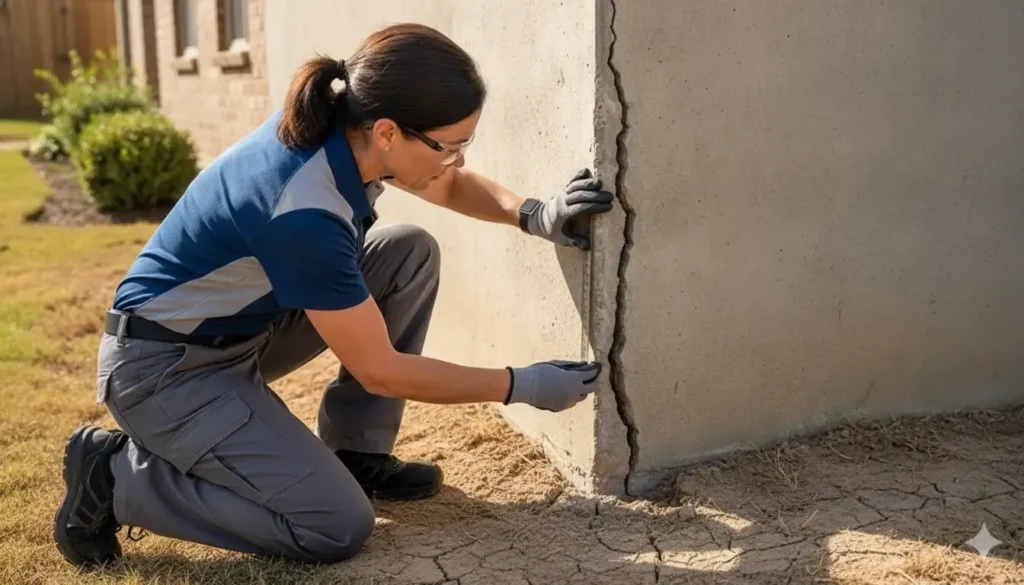
A foundation crack can make any North Texas homeowner wonder whether a minor blemish is warning of a larger problem. That concern is reasonable: expansive blackland-prairie clay responds to changing moisture, and soil movement can shift a structure enough to create cracks. The key is to evaluate the crack’s width, direction, offset, and whether it is changing over time.
Hairline vertical cracks are often cosmetic results of normal concrete curing, while cracks wider than about 1/8 inch, horizontal, stair-step, widening, or showing offset deserve prompt professional attention. If you are asking, do foundation cracks need repair, an early inspection can distinguish routine monitoring from structural work and help protect your home’s value.
Do not fill a foundation crack with soil or assume its appearance tells the whole story. A qualified specialist can assess the visible damage alongside related signs, such as sticking doors or windows, then recommend the right next step.
Schedule a free foundation inspection and call (940) 365-4221
Start by looking at the indicators that separate a harmless hairline crack from one that may reflect movement below the surface.
How Do You Know If Foundation Cracks Need Repair?
Seeing a crack in your foundation can make every settling sound in the house feel urgent. A measured look at the crack can help you decide how quickly to arrange an evaluation. Start with four signals: width, direction, vertical offset, and change over time. No single measurement tells the whole story, but the pattern can distinguish a common curing mark from evidence of active movement.
1. Measure the crack width
Hairline cracks under roughly 1/16 to 1/8 inch are often cosmetic. Concrete naturally loses moisture as it cures, and narrow shrinkage cracks are common during that process. In fact, all concrete cracks to some extent, and a stable hairline mark does not automatically indicate a structural problem. You can photograph the crack beside a ruler or use a simple crack-width card, then record the measurement rather than relying on appearance alone.
A crack wider than about 1/8 inch, particularly one approaching 1/4 inch, deserves closer attention. Wider openings may reflect foundation movement or pressure rather than ordinary curing. The width matters most when it appears with other warning signs, such as misalignment, wall displacement, or cracks that continue to grow.
2. Look at direction and shape
Direction provides useful context. Narrow vertical cracks can result from curing or thermal stress, especially when they remain unchanged. A vertical crack that widens from top to bottom, however, may be associated with settlement. Horizontal cracks in a foundation wall are more concerning because they can indicate soil pressure pushing inward against the wall. Stair-step cracks that follow mortar joints often point to uneven settlement in a specific area. Diagonal cracking can also deserve professional review when it is widening or paired with other movement.
3. Check for vertical offset
Run a straightedge across the crack or view it from the side. If one side sits higher than the other, the foundation may have moved out of alignment. This vertical offset is more meaningful than a crack’s appearance by itself because it suggests displacement, not just a surface opening. Also check nearby floors, walls, doors, and windows. Cracking indoors or doors that no longer latch can accompany exterior settlement.
4. Track whether it changes
Photograph the area from the same angle and date each image. Note changes in width, length, alignment, or offset over several weeks and after major rain or drought. A crack that is moving, spreading, or repeatedly reopening carries more concern than one that remains stable. These observations help a specialist evaluate the pattern and its likely cause.
So, do foundation cracks need repair? Hairline curing or shrinkage cracks are usually cosmetic, while wider, horizontal, stair-step, offset, or changing cracks indicate real movement that should not be dismissed. Only a professional foundation specialist can confirm whether a crack reflects normal adjustment or active foundation failure and recommend the appropriate response.
Why North Texas Soil Puts Foundations Under Stress
If a crack appears in your foundation, the soil beneath your home may be part of the explanation. North Texas sits over expansive clay, including the blackland-prairie soils common throughout the Dallas-Fort Worth area. Unlike relatively stable soils, expansive clay changes volume as its moisture content changes. Understanding that cycle helps explain why the same home can show different symptoms after a long dry spell, a major storm, or a season of uneven rainfall.
During drought, clay soil loses moisture and shrinks. As it contracts, it can pull away from parts of a slab or pier-and-beam foundation, leaving gaps and reducing uniform support. The building may shift as the soil beneath and around it moves. Fine-particle soils that shrink during dry conditions can remove support from a foundation and stress the concrete enough to produce cracks, according to North Dakota State University Extension.
When rain returns, the clay absorbs water and swells. That expansion can lift or press against different areas of the structure, especially where moisture is concentrated near one side of the home. A drought followed by heavy rain can therefore create movement in more than one direction. The result may be uneven settlement, new cracking, or a visible change in an existing crack.
This shrink-and-swell behavior is a leading driver of foundation instability in North Texas. Soil type is not a background detail when evaluating a crack. It is part of the diagnosis. A narrow vertical crack caused by ordinary concrete curing is not the same as a widening crack connected to active soil movement. The visible line may be small, while the underlying support conditions continue to change.
Soil movement can also show up indirectly inside the home. Doors may stick, stop latching, or seem to realign after the structure shifts. Windows can become difficult to open or close. These signs do not prove that a foundation has failed, but they become more meaningful when they occur alongside widening cracks, uneven floors, or changes around the exterior.
Homes in other regions can experience settlement, but North Texas homeowners must account for a distinctive expansive-clay environment. Consistent moisture management can reduce abrupt soil changes, yet it cannot determine whether a specific crack is cosmetic or structural. If cracking changes after weather cycles or appears with doors and windows that no longer operate normally. Consider a professional evaluation that examines the foundation and the soil conditions together.
Hairline Foundation Cracks: Usually Cosmetic, Still Worth Watching
A fine crack in a foundation can be unsettling, especially when you are already alert to the effects of North Texas soil. The good news is that many hairline cracks are a normal part of concrete’s life. As concrete cures, it loses moisture and shrinks slightly. Thermal movement and ordinary environmental stress can create narrow surface cracks without compromising the foundation’s ability to support the home.
Most of these cracks are cosmetic rather than structural. A narrow vertical crack that remains consistent in width, stays aligned, and does not show displacement is often non-structural. That pattern commonly reflects curing stress or temperature-related movement. Concrete is durable, but it is not completely crack-proof. In fact, all concrete develops some degree of cracking over time.
What makes a hairline crack less concerning?
Pay attention to the crack’s appearance and behavior rather than reacting to its presence alone. A hairline crack is generally less concerning when it:
- Remains narrow instead of gradually widening
- Runs vertically without stair-step or horizontal sections
- Does not have one side pushed outward or inward
- Appears without related symptoms elsewhere in the home
Take a clear photo and note the date and location. Recheck the area periodically under similar conditions. This simple record can show whether the crack is stable or changing, which is more useful than a single observation.
When should you take a closer look?
A hairline crack still deserves monitoring because conditions around the home can change. Expansive North Texas clay shrinks and swells as moisture levels shift. Soil movement can place new stress on a previously harmless crack and cause it to widen. A change in width, alignment, or direction deserves attention, particularly if it appears alongside sticking doors, drywall cracks, uneven floors, or other signs of movement.
That does not automatically mean the foundation requires repair. It means the visible crack should be considered in context. A foundation specialist can assess whether the pattern reflects normal adjustment or active movement, then recommend monitoring or action based on evidence. If you want to compare the patterns discussed here, review the different types of foundation cracks before deciding what to do next.
Structural Foundation Cracks: Signs That Call for Action
A crack deserves closer attention when its direction, shape, or movement suggests the foundation is responding to pressure or uneven support. In North Texas, expansive clay can shift as moisture levels change, placing stress on foundation walls. A horizontal crack may indicate soil pressure and potential inward bowing. Stair-step cracking that follows the mortar joints in a block or masonry wall commonly points to settlement in a specific section.
Width is another useful warning sign. Structural cracks are often wider than 1/8 inch, and some specialists use the 1/4-inch range as a stronger reason to seek evaluation. A crack does not have to reach that size to matter, however. Vertical offset, where one side sits higher than the other, indicates movement that a surface patch cannot explain. Cracks that widen, lengthen, or change alignment over time also warrant professional attention. Track those changes rather than judging the crack from a single snapshot.
| Crack type | Width | Direction | Movement over time | Typical cause | Recommended action |
|---|---|---|---|---|---|
| Hairline | Very narrow | Any | Usually stable | Normal curing shrinkage or minor thermal stress | Document and monitor |
| Vertical narrow | Narrow | Vertical | Usually stable | Curing or thermal movement | Monitor; request an assessment if it changes |
| Horizontal | Often wider than 1/8 inch | Horizontal | May widen or show bowing | Soil pressure against the wall | Arrange a professional evaluation promptly |
| Stair-step | Variable | Along block or masonry joints | May extend or offset | Uneven settlement | Arrange a professional evaluation |
| Widening or moving | Increasing | Any, especially diagonal or vertical | Clearly changing | Active movement or shifting support | Document changes and seek specialist guidance |
Look beyond the exterior wall, too. Interior drywall cracks, doors that no longer latch, or windows that stick can accompany exterior foundation movement. These symptoms do not prove a structural failure by themselves, but together they strengthen the case for an inspection. A specialist can distinguish normal adjustment from active movement and recommend a response based on the cause, not simply the visible crack. For context on the repair process, review our professional foundation crack repair guide. Early action gives you more options and can help prevent a small concern from becoming a larger structural problem.
How Foundation Piers Preserve Your Home’s Value
When a foundation crack reflects active settlement, filling the visible line is rarely the whole answer. The important question is what is causing the foundation to move and whether the structure has dependable support beneath it. In North Texas, expansive clay can shrink and swell as moisture conditions change. That movement can leave parts of a home with uneven support, especially when the soil directly below the foundation is no longer carrying the load consistently.
Support piers are one way a foundation specialist can address that deeper problem. Push piers and helical piers are engineered to transfer the structure’s load through the active, moisture-sensitive clay zone and into more stable soil strata below it. This creates a more dependable support path for the affected portion of the home instead of asking unstable near-surface soil to do a job it can no longer perform. The right system depends on the foundation type, site conditions, load requirements, and findings from the inspection.
Why earlier action can protect more than the foundation
Structural movement does not always remain limited to one crack. As settlement progresses, related signs can include uneven floors, doors that no longer latch, or additional cracking in interior and exterior finishes. Identifying structural signs early can help prevent further settlement and may simplify the repair scope. It also gives you a clearer record of the home’s condition, which is useful when you are planning maintenance, refinancing, or preparing to sell.
That does not mean every crack calls for piers. Narrow cracks caused by normal concrete curing may be cosmetic, while a widening, offset, diagonal, horizontal, or stair-step pattern deserves closer attention. A repair plan should follow evidence rather than assume the most extensive solution. The goal is to stop the source of movement and stabilize the affected area, not simply conceal the symptom with patching.
A free inspection is the practical way to determine whether piers apply to your home. A qualified specialist can evaluate crack patterns, changes over time, soil and drainage conditions, and other signs of movement before recommending a course of action. If you are unsure whether your foundation cracks need repair, schedule a free foundation inspection and get a diagnosis based on your home’s actual conditions.
Six Ways to Protect Your Foundation From Soil Movement
North Texas foundations experience a demanding cycle: expansive clay can swell when wet and shrink during dry periods. You cannot control the weather or change the soil beneath your home. But you can reduce abrupt moisture changes and catch warning signs before a small concern becomes a larger one. These practical habits support more stable conditions around the foundation.
- Keep moisture fairly consistent around the perimeter. Avoid allowing the soil beside the foundation to become severely dry and then saturating it during a sudden storm or heavy watering. A relatively constant moisture level helps limit the shrink-and-swell movement that can stress concrete. This is especially important through North Texas drought conditions, when gaps may develop as clay soil loses moisture. The goal is consistency, not creating soggy ground.
- Water 1 to 2 feet away from the foundation edge. If the soil is pulling away from the foundation during a dry spell, apply water gradually at the recommended distance rather than directing a hose into the gap. Water added directly to a crack or opening can travel toward the wall and contribute to basement water intrusion. Soil can also carry moisture several feet through its profile, so placement matters even when the surface looks dry. These guidelines are documented by North Dakota State University Extension.
- Manage gutters and surface drainage. Gutters, downspouts, and grading should carry rainwater away from the foundation instead of allowing it to pool beside the slab or wall. Check that downspout discharge does not empty at the foundation edge, and correct low areas where runoff collects. Drying soil can leave a gap beside a foundation wall, giving rainwater a path down the wall and into a basement.
- Do not backfill a gap beside the foundation wall with soil. Filling an opening may seem like a quick fix, but wet soil expands. That added pressure can push against the wall and potentially worsen cracking. Before adding material or sealing a visible gap, consider documenting its size and asking a professional to identify the cause.
- Monitor cracks and changes inside the home. Photograph a crack from the same angle, note its approximate width and location, and record the date. Recheck it periodically for widening, new offsets, or changes in alignment. Also watch for doors or windows that begin sticking, fail to latch, or change as the crack changes. A record gives an inspector useful evidence instead of relying on memory. For additional context, review these common causes of foundation cracks.
- Schedule a professional foundation inspection when anything is uncertain. A specialist can evaluate the crack pattern, surrounding soil, drainage, and related symptoms together. That broader assessment helps distinguish normal concrete adjustment from active movement and avoids treating only the visible surface. Periodic inspections and documentation can identify minor shifts early, when the appropriate response may be simpler than it would be after continued movement.
These steps help manage risk, but they cannot confirm whether a particular crack needs repair. If a crack is changing or appears alongside drainage problems, sticking doors, or uneven floors, an evidence-based inspection is the clearest next step.
Why a Professional Inspection Is the Reliable Answer
A foundation crack can look minor in isolation, yet its meaning depends on more than appearance. Hairline cracking may reflect normal concrete shrinkage, while a wider crack, a visible offset, or a change in alignment can point to movement. The most useful evidence is not a single measurement taken once. It is the crack’s size, shape, alignment, and trend over time. Guidance from North Dakota State University Extension notes that crack size and changes in alignment can help determine whether a foundation may require repair: review the source guidance on foundation crack assessment.
That distinction is difficult to make from a photograph or a quick glance. A qualified foundation specialist can assess whether the cracking reflects normal building adjustment or active foundation failure requiring intervention. The evaluation should consider the location and direction of the crack, whether its edges have shifted, and whether related symptoms appear elsewhere. Doors that no longer latch, drywall cracks, uneven floors, or changes around exterior walls can provide important context. So can the home’s soil conditions, drainage, and history of moisture changes. In North Texas, expansive clay can swell when wet and shrink when dry, so the surrounding conditions matter as much as the visible line in the concrete.
A reliable repair recommendation starts with a diagnosis, not a patch. Filling or sealing the visible crack may improve its appearance. But it does not resolve an underlying support or moisture problem if soil movement is still affecting the structure. Foundation repairs should address the cause of movement, whether that involves drainage, soil support, stabilization, or another condition identified during the inspection. This approach helps avoid treating a symptom while the larger problem continues.
Documentation also makes the decision clearer. A specialist can record crack locations, dimensions, alignment, and related symptoms so future changes have a meaningful baseline. Periodic inspection and documentation can identify minor shifts before they develop into more significant structural problems. If a crack is stable and cosmetic, that evidence can provide reassurance. If it is changing, the record helps guide timely action and a focused repair plan.
When you are weighing whether foundation cracks need repair, a professional inspection replaces uncertainty with evidence. Solid Base Foundations offers a free inspection and estimate for homeowners who want the condition assessed in context.
Schedule a free foundation inspection and estimate, or call (940) 365-4221
Frequently Asked Questions
Do all foundation cracks need to be repaired?
No. Narrow hairline cracks often result from normal concrete shrinkage during curing and may be cosmetic. Still, track their size, shape, and alignment over time. Changes, widening, or related movement elsewhere in the home justify a professional assessment.
When should you worry about foundation cracks?
Pay closer attention when a crack is wider than 1/8 inch, runs horizontally, follows a stair-step pattern, or shows visible offset. Sticking doors, windows that no longer close properly, or several new cracks can also indicate soil movement affecting the structure.
Are hairline foundation cracks normal?
Often, yes. Vertical hairline cracks can develop as concrete cures or responds to normal thermal changes. A narrow crack is less concerning when it remains stable and is not paired with wall displacement, water intrusion, or other signs of settlement.
How do I know if a foundation crack is structural?
Direction and change over time provide useful clues. Horizontal cracks may reflect soil pressure against a wall, while stair-step or widening diagonal cracks can indicate uneven settlement. A foundation specialist can evaluate the crack pattern and the surrounding structure together.
Can I repair foundation cracks myself?
You can monitor a minor, stable cosmetic crack and follow appropriate sealing guidance. Avoid treating a structural-looking crack as a surface defect. If it is widening, offset, horizontal, or accompanied by movement, arrange a professional evaluation before choosing a repair.
Ready to Schedule a Free Foundation Inspection?
If you are still unsure whether a crack is cosmetic or a sign of movement, a professional assessment can give you a clearer next step. Solid Base Foundations offers free inspections for North Texas homeowners, so you can discuss what you are seeing without guessing about the right solution.
Schedule a free foundation inspection with Solid Base Foundations at (940) 365-4221