
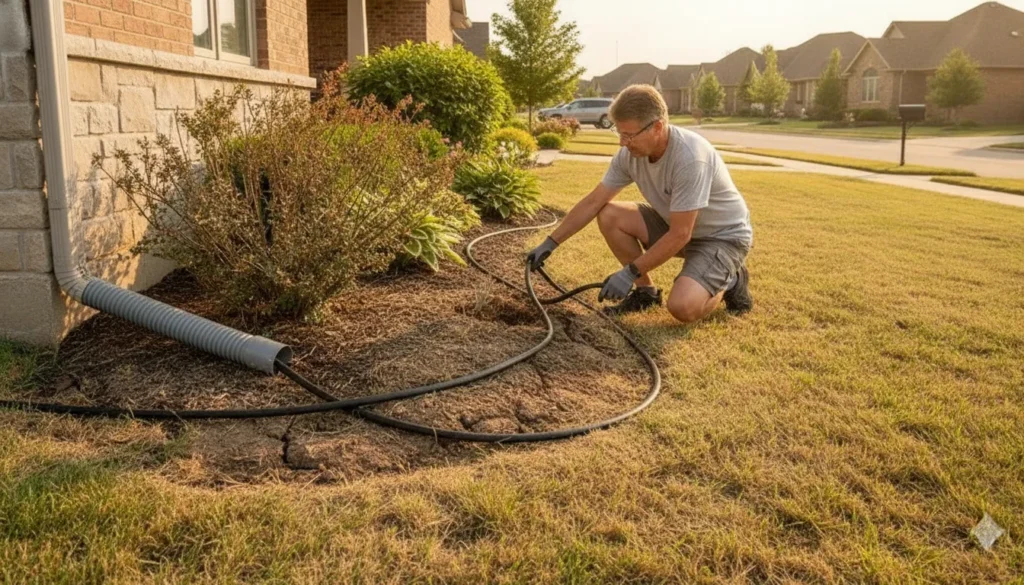
North Texas droughts affect more than lawns and landscaping. This guide explains how to prevent foundation damage drought conditions can trigger when expansive clay soil loses moisture and contracts unevenly. A consistent moisture plan, controlled irrigation, and reliable drainage can reduce avoidable stress around a slab or pier-and-beam home.
Request a free foundation assessment from Solid Base Foundations, (940) 365-4221.
The most useful drought precautions are simple: monitor the soil around the foundation, maintain even moisture without creating standing water. Keep gutters and downspouts working, and watch for changes in cracks, doors, windows, floors, or adjoining concrete. These steps help you manage site conditions, but they do not diagnose structural movement. Persistent or worsening signs deserve a property-specific assessment.
North Texas homes need a different approach from homes built on non-expansive soil. Blackland prairie clay can shrink as it dries and swell as it absorbs water. The risk is often greatest when moisture varies from one side of the structure to another, or when a long dry period is followed by concentrated runoff. Prevention is therefore less about flooding the yard and more about avoiding sharp, uneven changes.
Use this guide as a maintenance framework. It will help you identify conditions worth correcting, understand what controlled watering can and cannot do, and recognize when professional input is the sensible next step.
Why Does a Texas Drought Put Stress on Your Foundation?
Soil supports a foundation, so changes in the soil can affect the structure above it. During an extended dry spell, heat and limited rainfall remove moisture from the ground. Expansive clay contracts as it dries. If that contraction happens unevenly, one portion of a foundation may lose support or move differently from another portion.
The Dallas-Fort Worth area includes expansive clay soils associated with the region’s blackland prairie. The GeoInstitute guide to shrink-swell soils explains why the volume of these soils changes with moisture. That regional geology is why a drought plan should address the soil around the entire home, not just the most visible crack or the driest flower bed.
Dry weather alone does not automatically mean a foundation has been damaged. Site conditions matter. Trees may draw moisture from nearby soil. A broken sprinkler head may saturate one small area. A shaded side of the home may retain moisture while a sunny side dries quickly. A downspout may discharge at the footing during the first heavy storm after weeks without rain.
These differences can create movement patterns that are difficult to interpret from a single observation. A slab-on-grade foundation and a pier-and-beam foundation also respond through different support systems. A property inspection should consider the foundation type, grade, drainage, vegetation, irrigation, and the timing of any visible changes together.
Why uneven moisture matters more than a dry lawn
A brown lawn is not, by itself, proof of foundation trouble. The more useful question is whether moisture conditions around the structure are becoming sharply different. Look for soil pulling away along one wall, an irrigated bed beside an unwatered side, ponding near a downspout, or a low area that changes after a storm.
Keep a simple dated record of unusual conditions and visible changes. Photograph the same exterior locations from a similar angle. Inside the home, note when an opening starts sticking or when a floor feels different. A record will not identify the cause, but it can show whether a condition is stable, recurring, or progressing.
Practical Ways to Prevent Foundation Damage in a Drought
To prevent foundation damage during drought, manage the perimeter as one connected system. Soil moisture, landscape grade, plantings, irrigation, gutters, and downspouts all influence how water moves around the structure. The objective is controlled consistency, not saturation.
-
Inspect the soil and foundation perimeter
Walk the full perimeter of the home, including sides that are difficult to see from the street. Look for gaps between soil and foundation walls, depressions, erosion, exposed footing areas, or places where water collects. Check where patios, driveways, and walkways meet the structure. Record changes instead of filling a gap immediately, because the location and timing may help explain the moisture pattern.
-
Check irrigation coverage and equipment
Run each irrigation zone long enough to observe the spray pattern, but follow current local watering rules. Look for broken heads, leaks, overspray, blocked coverage, and water directed against the foundation. A slow, even application across the surrounding soil is preferable to a concentrated stream in one location. Do not assume a timer is working correctly without checking what the system actually delivers.
-
Maintain reasonable moisture near the structure
During prolonged dry weather. The goal is to avoid allowing the soil near the foundation to become severely dry and then applying a large amount of water all at once. If watering is appropriate for the property and local restrictions, use measured coverage and observe how quickly the soil absorbs it. Stop when water begins to run toward the structure or collect at the surface.
-
Review trees, shrubs, and planting beds
Vegetation affects moisture distribution. Large or water-demanding plants can draw moisture from soil near the foundation, while dense beds may conceal cracks or drainage problems. Maintain clear observation areas along the perimeter. Before adding or removing substantial landscaping, consider how the change may alter shade, roots, irrigation, and runoff around the home.
-
Recheck after major weather changes
Inspect the same areas after a long dry period, a heavy storm, or a significant change in irrigation. Drought and intense rainfall can occur in the same season. What matters is whether water is being managed consistently and whether the home shows new or worsening movement indicators.
These measures support moisture management. They cannot correct a foundation problem that is already established. If conditions remain uneven after maintenance adjustments, review the situation with a professional rather than making increasingly aggressive changes to the landscape.
What Is the Right Way to Water Around a Foundation?
Watering around a foundation requires restraint and observation. The common mistake is treating the slab like a plant that should be soaked whenever the soil looks dry. A foundation perimeter needs controlled moisture and effective drainage, not standing water.
Choose slow, even coverage
Use irrigation that distributes water across the soil near the structure without spraying directly against the wall or slab edge. Avoid a hose stream that washes soil away or creates a channel. If a soaker hose or another low-flow method is used, place it so the application is even and does not sit directly against the foundation. Follow municipal restrictions and adjust for actual rainfall.
Observe the ground while the system runs
Walk the perimeter while watering. Look for runoff, pooling, exposed soil, or an area that becomes wet much faster than the rest. Correct a broken head or leaking line rather than compensating by adding more water elsewhere. Water should infiltrate gradually. It should not be forced into cracks, directed under a slab, or allowed to collect beside a crawl space.
Do not chase a crack with extra water
A crack or gap is a reason to investigate conditions, not a reason to aim a hose at one spot. Concentrated watering may make moisture differences worse and can obscure the original problem. If a visible change continues after irrigation and drainage are brought under control, document it and consider a foundation assessment.
The foundation settlement repair guide provides additional context on movement and support concerns. It is useful to compare that information with what you observe, while keeping in mind that online guidance cannot replace a site-specific review.
How Should You Route Drainage During a Drought?
Drought does not remove the need for drainage. In North Texas, a dry season can be followed by a high-intensity storm. If gutters are clogged or downspouts discharge beside the house, the first major rainfall may create a concentrated wet area next to soil that has been unusually dry.
Start at the roof. Clear leaves and debris from gutters, then check that water reaches the downspouts instead of spilling over the fascia. Inspect each downspout outlet during rainfall or a controlled test. Water should move away from the foundation and should not erode a channel back toward the house.
Next, review the grade. Low spots beside the foundation can collect water even when the rest of the yard appears dry. Do not pile soil against siding or cover a foundation wall’s visible inspection area. If grading needs substantial correction, get advice on the appropriate solution for the foundation and drainage layout.
Also check hardscape. A settled driveway, patio, or walkway can change the direction of runoff. Concrete that slopes toward the house may send water to the foundation during every storm. Solid Base Foundations provides concrete repair services for uneven concrete concerns, but drainage and structural conditions should be evaluated together when a hard surface has settled near the home.
For general building-moisture principles, review the EPA moisture-control guidance. The specific correction for a property depends on its grade, soil, foundation, roof drainage, and existing site features.
Which Foundation Warning Signs Should You Monitor?
Monitoring is most useful when it is consistent. A single small crack may have several possible explanations, while a pattern of changes across the home deserves closer attention. Use photographs, dates, and locations to distinguish an isolated condition from movement that continues through changing weather.
Exterior signs
- New or widening cracks in brick, masonry, stucco, or the foundation wall.
- Gaps where the foundation meets soil, porches, patios, or walkways.
- Soil pulling away along one section of the perimeter.
- New depressions, erosion channels, or repeated ponding beside the home.
Interior signs
- Doors or windows that begin sticking without another obvious explanation.
- Cracks that recur around door frames, windows, ceilings, or interior walls.
- Noticeable changes in floor level or separation between trim and walls.
- Several changes appearing in different rooms during the same period.
Patterns that deserve a closer look
Pay attention when a visible change lines up with a drainage or moisture issue. For example, a crack near a low area, a sticking door on the dry side of the home. And a downspout that discharges against the foundation may be more meaningful together than separately. These observations do not prove a structural cause, but they can help a professional focus the assessment.
See Solid Base Foundations’ guide to early signs of foundation problems for more examples. Avoid cosmetic repairs that hide a changing crack before you understand whether the underlying condition is stable.
Talk with Solid Base Foundations about drought-related foundation concerns, (940) 365-4221
When Is a Foundation Assessment the Right Next Step?
Consider an assessment when signs persist after you correct obvious drainage or irrigation problems, when several warning signs occur together, or when a change is getting worse. A professional can review the structure and the surrounding conditions instead of treating one symptom in isolation.
Timing matters during and after a drought
Do not wait for a dramatic failure before documenting a concern. An assessment during a dry period may show the conditions that coincide with the movement. A follow-up after significant rainfall can add useful context. If a crack, gap, or uneven area remains after weather conditions change, an assessment can help determine whether the condition is cosmetic, maintenance-related, or structural.
Slab and pier-and-beam homes need different review points
A slab foundation distributes support through the slab and its bearing areas. A pier-and-beam home relies on individual supports and the framing above them. The inspection points and repair considerations are not identical. Share the foundation type, the locations of changes, recent weather, irrigation adjustments, tree conditions, and drainage observations with the professional who evaluates the property.
Solid Base Foundations offers a free estimate process that begins with an on-site review and a discussion of the property’s condition. That conversation can help you understand available next steps without guessing at a repair based only on a photograph or a general online checklist.
| What you observe. | Useful next step. |
|---|---|
| Soil pulling away, erosion, or isolated ponding. | Photograph the location and check grade, irrigation, gutters, and downspout discharge. |
| A new crack, sticking opening, or floor change. | Record its location and timing, then compare it after weather conditions change. |
| Several signs or persistent movement. | Request a site-specific foundation assessment instead of relying on a surface repair. |
Frequently Asked Questions
Should you water your foundation during a drought?
Controlled watering may help maintain more consistent moisture around a North Texas foundation during extended dry weather. But the goal is not to soak the slab or create standing water. Use even coverage, follow local restrictions, watch for runoff, and correct irrigation problems. If the property has visible cracks, gaps, or movement, consider an assessment before changing the watering routine significantly.
How do you prevent water damage to a foundation?
Keep water from collecting beside the structure. Maintain gutters, route downspouts away from the home, correct low spots, and check irrigation for leaks and overspray. Use measured watering rather than alternating between severely dry soil and concentrated saturation. Drainage, grade, and foundation conditions should be reviewed together when water repeatedly reaches the perimeter.
Can dry weather cause foundation problems?
Dry weather can contribute to movement when expansive North Texas clay loses moisture and contracts. The risk may increase when trees, irrigation, shade, or drainage create uneven moisture conditions around the home. Watch for recurring cracks, sticking openings, floor changes, or separation near hardscape. These signs do not establish a cause by themselves, but persistent changes justify closer review.
How long does water take to damage a foundation?
There is no reliable universal timeline. Risk depends on the source and volume of water, soil, drainage, foundation type, and whether moisture remains concentrated beside the structure. A single storm does not automatically mean damage, but repeated ponding or a leaking downspout should be corrected promptly. Monitor the area through both dry and wet weather.
Ready to Protect Your Foundation During Drought?
A sensible drought plan starts with observation. Keep soil moisture as consistent as practical, route roof runoff away from the home, check irrigation and landscaping, and record changes instead of guessing at the cause. If concerns persist, a professional assessment can clarify the condition and the options available for your property.
Request a free foundation assessment from Solid Base Foundations, (940) 365-4221