
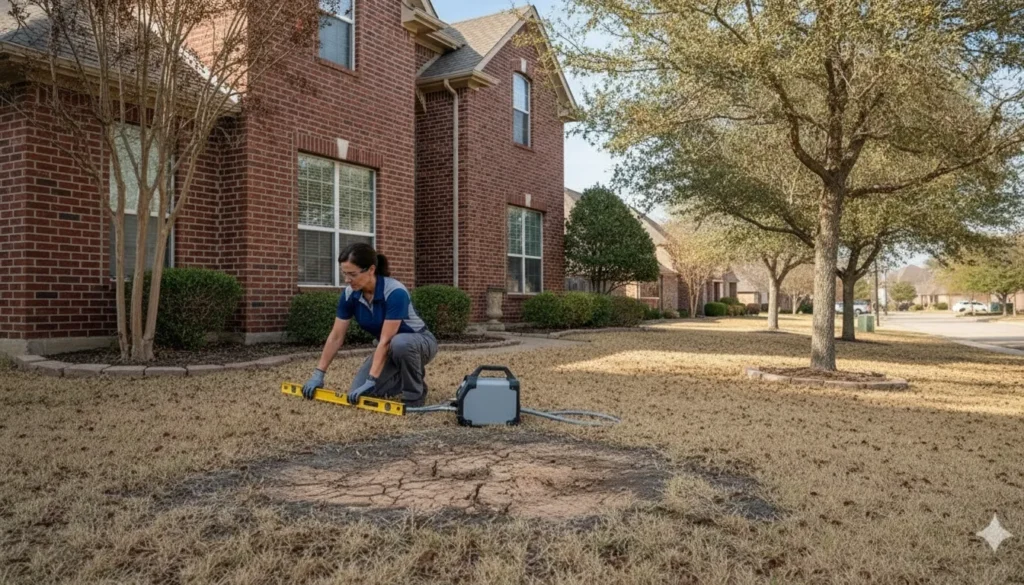
Cracks that widen near a window, doors that begin to stick, or a floor that feels subtly out of level can make any homeowner uneasy. In Greater Dallas, those changes often deserve closer attention because expansive clay soil can swell when wet and contract as it dries. This can move different parts of a foundation by different amounts.
A differential settlement foundation moves unevenly. Even, or uniform, settlement affects the structure more consistently and is generally less likely to create structural damage. The pattern of movement matters: symptoms can point to settlement, but they do not prove its cause. A professional evaluation can help distinguish soil movement from other conditions. Depending on the findings, the next step may be monitoring, drainage improvements, or a pier system that transfers loads to deeper, more stable soil.
Understanding what moves, why North Texas soil responds the way it does, and how engineers interpret the signs starts with the meaning of differential settlement itself.
What does differential settlement mean for a foundation?
Seeing a new crack, a sticking door, or a floor that feels uneven can be unsettling. Those signs do not automatically prove structural damage, but they can indicate that different parts of your foundation are moving differently. That pattern is called differential settlement.
Differential settlement occurs when one portion of a foundation sinks farther or faster than another portion. The movement may develop between two sides of a slab, near an addition, or where soil conditions vary beneath the structure. Because the building remains connected while its supports move unevenly, the foundation and framing can experience stress. The MIT-hosted foundation movements reference explains why engineers generally focus more on differential settlement than on the total amount of settlement alone.
How is uniform settlement different?
Uniform settlement means the structure moves downward at roughly the same rate and amount across its footprint. A building can settle uniformly without developing the same concentration of stress that uneven movement creates. The Newcastle foundation engineering text notes that uniform settlement rarely causes structural damage compared with differential settlement. In practical terms, an even change may be less disruptive than one corner or wall line moving independently from the rest of the home.
| Movement pattern. | What it means. | Why it matters. |
|---|---|---|
| Uniform settlement. | Most of the structure moves down by a similar amount. | It is generally less likely to concentrate stress in connected parts. |
| Differential settlement. | One area moves farther or faster than another. | Uneven support can stress framing, walls, floors, and openings. |
Uneven movement can distort the structure’s geometry. As one area drops or another remains supported, framing may bend or shift. That can place stress on connected walls, floors, ceilings, masonry, and openings. The resulting pattern may include cracks or misalignment, but the appearance alone does not reveal the cause or severity. Differential movement can distress framing, as documented in the cited expansive-soil research, yet not every crack in a home is structural.
Why does the distinction matter?
Settlement is influenced by more than one factor. Structural loading, soil response, consolidation, and changes in groundwater conditions can all contribute to foundation movement. In North Texas, expansive clay adds another variable: it expands as it absorbs water and contracts as it loses water. If moisture conditions differ beneath separate portions of a foundation, the resulting movement may also differ.
That is why a symptom should be treated as a reason to evaluate the pattern, not as a diagnosis. The UC Davis foundation settlement guidance identifies sticking doors and windows, cracks, and impaired load resistance among possible effects of differential settlement. A qualified assessment considers where symptoms appear, whether they are changing, and how the soil and structure interact before anyone recommends monitoring, drainage work, or a structural repair.
Why is differential settlement common in North Texas?
North Texas homes sit in a region where soil behavior can change substantially with moisture. Expansive clay absorbs water and expands, then contracts as it loses water. When that movement is not uniform beneath a foundation, different areas can rise, fall, or shift at different rates. That uneven response helps explain why a differential settlement foundation can develop stress even when the house appears sound from the street.
The regional geology matters because blackland prairie soils contain expansive clays that respond to wet and dry conditions. The cycle is not a single-direction sinking event. One portion of the soil may swell while another portion dries and shrinks, depending on local moisture conditions. The result can be uneven support across the foundation footprint rather than a consistent change affecting the entire structure.
The American Society of Civil Engineers Geo-Institute explains that shrink/swell soils can create damaging up-and-down movement in foundations and structures as soil moisture changes. It also identifies uniform moisture next to and beneath the foundation as an important way to reduce the effects of that movement. Read the Geo-Institute guide to shrink/swell soils for additional background.
How can moisture vary around one home?
Moisture differences can develop at the edge of a slab, beneath one side of a home, or near areas that drain differently. A leaking or poorly directed source of water may leave one area wetter, while prolonged drying can pull moisture from another. Vegetation can also be relevant when it changes local soil moisture, but no single condition proves that it caused foundation movement. The soil profile, foundation type, loading, drainage, and changing water conditions all influence how a property responds.
That is why a professional evaluation should look at patterns rather than assign a cause from one crack or one tree. The Geo-Institute notes that indicators such as diagonal masonry cracks, gaps near windows, sticking doors or windows, sloping floors, and concrete floor cracks can occur with shrink/swell movement. These signs support closer evaluation, but they are not standalone diagnoses.
For a clearer explanation of how regional clay can affect a home, review this North Texas expansive clay soil guide. Understanding the soil mechanism can help you describe changes accurately when discussing the property with a foundation professional, without assuming that every visible defect requires the same response.
Which signs suggest uneven foundation movement?
Cracks and sticking doors can make any homeowner uneasy, especially when they appear without an obvious cause. These changes often reflect ordinary seasonal movement, but a pattern of symptoms across several areas can justify a closer evaluation. In North Texas, expansive clay absorbs water and expands, then contracts as it dries. That movement may affect different parts of a structure by different amounts.
The GeoInstitute explains that moisture changes in expansive soils can produce damaging upward and downward movement. The signs below are useful clues, not proof of a differential settlement foundation problem.
Cracks that follow a pattern
Diagonal cracks in brick, masonry, or drywall deserve attention, particularly when they appear near the corners of doors and windows. Cracks that radiate from openings can reflect stress concentrating around those weaker points. You may also notice cracks that widen or return after cosmetic patching. A single hairline crack can have a number of explanations, while several aligned cracks on one side of a home provide more meaningful context.
Openings, floors, and gaps that change
Sticking doors or windows may indicate that the framing has shifted enough to affect the opening. Look for doors that swing open or closed on their own, uneven reveals around a frame, or windows that become difficult to operate. Other possible clues include sloping floors, gaps between baseboards and flooring, separation at trim, and spaces appearing between walls and ceilings. These symptoms can result from movement in the foundation or framing, but they can also reflect moisture, age, installation, or localized damage.
As UC Davis notes, settlement-related movement can contribute to sticking doors and windows, cracking, and changes that affect how structural loads are carried. That does not make every symptom a diagnosis. An experienced professional considers the location, direction, age, and progression of each sign alongside drainage conditions, soil moisture, and the building’s construction.
Document changes with dated photographs, and note whether symptoms appear seasonally or continue to progress. For a broader checklist, review these early foundation warning signs. A pattern-based assessment is more reliable than reacting to one crack in isolation.
How is a differential settlement foundation evaluated?
Cracks, sticking doors, or a floor that feels uneven can make your home feel uncertain. Those symptoms deserve attention, but none proves a single cause on its own. A professional evaluation looks at the pattern of movement and the conditions around the structure before recommending a response.
That distinction matters in North Texas, where expansive clay can swell as it takes on water and contract as it dries. Moisture differences around a home may contribute to uneven movement, but soil response is only one part of the assessment. A qualified professional considers the building as a whole rather than relying on one visible defect.
- Review the symptom history. The assessment begins with what you have observed and when you observed it. Share whether cracks appeared recently or have changed over time, whether doors or windows began sticking, and whether drainage or moisture conditions changed near the home. This history helps distinguish a persistent pattern from an isolated cosmetic issue. It is helpful to bring dated photographs if you have them, but avoid treating them as a diagnosis.
- Map the location and pattern of distress. The evaluator considers where cracks and gaps occur, their direction, and how they relate to walls, openings, corners, floors, or other parts of the structure. Diagonal masonry cracks, gaps near windows, sticking doors and windows, sloping floors, and concrete floor cracks can indicate movement, according to the GeoInstitute’s guidance on shrink-swell soils. They are indicators, not standalone proof of differential settlement.
- Observe floors, openings, and interior connections. Doors that no longer close cleanly, windows that bind, visible floor transitions, and gaps at trim can show how movement may be affecting the structure. An evaluator considers several observations together, including whether the same area shows more than one related symptom. Settlement can create cracks and interfere with a building’s load resistance, as summarized by UC Davis engineering guidance.
- Examine exterior grading, drainage, and moisture context. Water flow, wet or dry areas near the foundation, landscaping, and changes in surface moisture can help explain why soil may behave differently from one location to another. Expansive clay responds to changing moisture, so the surrounding site context matters. The evaluation should consider these conditions without assuming that every drainage issue or crack is the original cause.
- Assess whether movement appears active. The professional brings the history, symptom patterns, interior observations, and exterior conditions together to determine whether the evidence suggests ongoing or established movement. The result may support further monitoring, drainage improvements, or a structural repair plan. Where repair is appropriate, the response should follow the findings rather than a preset solution. Homeowners should not self-diagnose differential settlement or select a repair system from a symptom checklist alone.
A careful evaluation gives you a clearer basis for deciding what to do next. It also helps separate normal maintenance concerns from movement that may be affecting the foundation and framing. For a plain-language overview of what a site visit may involve, review Solid Base Foundations’ foundation repair process guide.
How can piers address differential settlement?
When one part of a structure has lost support, a repair plan may use piers to create a more reliable load path. A pier is a structural support installed below or alongside the existing foundation. Depending on the building, soil conditions, foundation type, and movement pattern, an engineer or qualified foundation professional may consider push piers or helical piers as part of the solution.
These systems can transfer structural loads through weaker near-surface soil and into deeper, more stable soil layers. That principle is consistent with the way deep foundation elements carry building loads to stronger strata. The Massachusetts Institute of Technology reference on foundation movements explains that foundation loads can be transferred to deeper supporting layers. The goal is not to apply the same repair everywhere. It is to match the support system to the actual load and soil conditions beneath the affected area.
Push piers and helical piers serve different conditions
Push piers are hydraulically advanced through the soil until they reach a layer capable of supporting the required load. Helical piers use steel shafts with helix plates that are rotated into the ground. Their installation method and capacity make them useful in different repair circumstances. Neither option is automatically appropriate simply because a home shows cracks or sloping floors.
An evaluation should identify where movement occurred, how the foundation is carrying loads, and whether the supporting soil remains vulnerable to moisture-related change. The resulting design may call for support at selected sections rather than beneath the entire structure. This targeted approach helps avoid treating visible symptoms without understanding the movement pattern.
Support is only one part of a durable repair plan
Piers can improve support at locations affected by uneven movement, but they do not eliminate every possible cause of foundation distress. In North Texas, expansive clay absorbs water and expands, then contracts as it dries. Uneven moisture around a structure can contribute to movement, so drainage and water-management concerns may belong in the broader repair plan when the evaluation identifies them. The GeoInstitute explains that keeping moisture conditions more uniform next to and beneath a foundation can reduce the effects of shrink-swell soils: read the guide to living with shrink-swell soils.
That is why a pier recommendation should follow an assessment rather than a generic guarantee. A professional can review the foundation type, soil behavior, drainage conditions, and structural symptoms before outlining appropriate options. If you are comparing possible approaches, the foundation settlement repair guide provides additional context on why repair design depends on the pattern and cause of movement.
What should homeowners do after spotting signs?
Once you notice a recurring crack, sticking door, or uneven area, resist the urge to judge the problem from one symptom alone. A differential settlement foundation issue can develop gradually, and the pattern across your home often matters more than the appearance of one isolated mark.
Start by documenting what you see. Note each location, the approximate date you first noticed it, and whether it changes after heavy rain, a dry spell, or another noticeable shift in soil moisture. Take clear photographs from the same angle over time. Include nearby doors, windows, floors, baseboards, and exterior masonry if they show related changes. This record gives an assessor useful context and helps separate a persistent pattern from a one-time cosmetic issue.
Next, look at the conditions around the affected area. Check whether downspouts discharge near the foundation, whether water collects beside the home, or whether one section of soil stays noticeably wetter or drier than another. In North Texas, expansive clay can expand as it absorbs water and contract as it loses water, so uneven moisture conditions may contribute to movement. The differential settlement foundation repair guide provides additional context on how settlement concerns are evaluated and addressed.
Do not assume that filling a crack or adjusting a door solves the underlying cause. Cosmetic work may improve the visible finish while movement continues below it. At the same time, not every crack proves structural damage. An assessment should consider the location, timing, concentration of signs, drainage conditions, soil response, and the way loads move through the structure.
Consider arranging an evaluation when signs persist, appear in several connected areas, or cluster around one portion of the home. Bring your photographs and notes, and mention any drainage or moisture changes you have observed. A professional can then determine whether the appropriate next step is monitoring, drainage-related work, targeted repair, or a structural support approach. Push piers or helical piers may be considered in some cases, but the system and repair area should follow the findings rather than a symptom alone. A focused review of gaps between walls and floors can also help you describe a related symptom clearly, while the assessor determines its cause.
Frequently Asked Questions
Can a foundation settle evenly without causing major damage?
Often, yes. Uniform settlement means the structure moves downward at a similar rate across its footprint, which is generally less damaging than differential settlement. Uneven movement creates additional stress in framing, walls, and finishes, so the pattern and location of movement matter as much as the amount.
Why does North Texas clay contribute to differential settlement?
Expansive clay changes volume as its moisture content changes. It expands when it absorbs water and contracts as it dries. Differences in drainage, shade, vegetation, or soil moisture can make one part of a foundation move differently from another. The GeoInstitute guide to shrink-swell soils explains why these moisture changes can produce damaging movement.
Do cracks or sticking doors prove that my foundation is settling?
No. Diagonal masonry cracks, gaps around windows, sloping floors, and sticking doors or windows can indicate foundation movement, but none is a standalone diagnosis. Seasonal expansion, framing movement, plumbing issues, and other conditions can create similar symptoms. A professional should evaluate the pattern, location, and progression together.
What happens during a differential settlement evaluation?
An evaluation typically considers the home’s movement history, the location and pattern of visible symptoms, floor or elevation changes, drainage conditions, and soil moisture factors. The goal is to identify the likely cause before selecting a response. Depending on the findings, the appropriate recommendation may involve monitoring, drainage improvements, or a structural support system such as push or helical piers.
Get started with a professional foundation assessment
Uneven movement can have several possible causes, and a professional assessment can help clarify what your home is experiencing before you plan next steps. If you are seeing signs associated with differential settlement, ask Solid Base Foundations about a free estimate and foundation evaluation.
Request a free foundation assessment or call (940) 365-4221.