
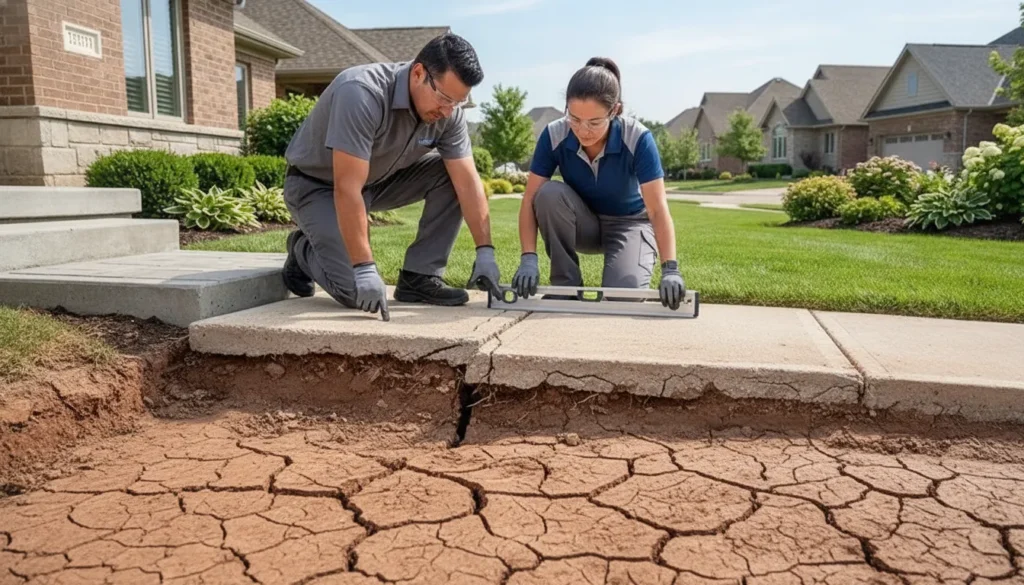
When a floor rises, doors begin to stick, or cracks appear in several parts of your home, it is understandable to wonder whether the foundation is settling. In North Texas, the opposite can also happen. Expansive blackland prairie clay absorbs excess moisture, swells, and can push a foundation upward. That movement often affects one part of a structure more than another, creating the differential distress identified in foundation engineering research.
Foundation heave is the upward movement of a structure caused by expansive clay soil swelling after it absorbs too much moisture. Unlike settlement, which moves a foundation downward, heave pushes sections upward and can distort floors, walls, doors, and windows. The right response starts with identifying the moisture pattern and measuring the movement, not guessing from a single crack.
Understanding expansive clay soil behavior makes the difference easier to see. Next, we will define what foundation heave looks like and why it is often mistaken for settling.
Concerned your floor is lifting? Schedule a free foundation inspection and get a professional read on what is happening before the movement spreads.
What Is Foundation Heave?
If you notice cracks, sloping floors, or doors that suddenly stick, it is understandable to assume your home is settling. Most homeowners hear about foundations sinking, not moving upward. Foundation heave describes the opposite problem: the upward movement of a structure when expansive clay soil absorbs excess moisture, swells, and presses against the foundation.
That distinction matters because the visible symptoms can overlap. A door may bind, a wall may crack, or a floor may feel uneven whether one part of the foundation moves down or another part moves up. The location and pattern of the movement provide important clues, but a single symptom rarely identifies the cause on its own.
How heave moves a foundation
Expansive clay acts differently from stable, free-draining soil. When the clay beneath a home takes on more water, its particles expand. If that swelling occurs unevenly, one area of the foundation can rise more than another. The structure then experiences differential movement rather than a smooth, uniform lift.
In North Texas, this process deserves particular attention because homes often sit on clay that responds to changing moisture conditions. Heavy rain, drainage problems, plumbing leaks, or concentrated irrigation can create wetter zones beneath or alongside the foundation. Those zones may swell while nearby soil remains relatively unchanged. The resulting pressure can push sections of a slab or pier-and-beam foundation upward.
Why homeowners often mistake heave for settlement
Settlement has become the familiar foundation concern, so people often use that explanation for every structural change. A raised section can create a low point elsewhere, making the home feel as if part of it has sunk. For example, when one side rises, the adjoining area may appear lower by comparison. Cracks can also form in both situations, although their pattern, location, and relationship to other signs can differ.
Heave also does not always happen quickly or dramatically. Moisture changes in expansive clay can develop gradually, allowing small shifts to accumulate before you notice them. Seasonal movement may make a door stick during a wet period and operate more normally later, but recurring changes still deserve attention.
A professional evaluation can distinguish upward movement from settlement by examining floor elevations, crack patterns, drainage conditions, and the foundation system. That assessment helps identify whether moisture control, monitoring, or structural stabilization makes sense for your home. Recognizing foundation heave early gives you a clearer path forward and avoids treating an upward soil movement as though the foundation were simply sinking.
Why Expansive Clay Soil Under Dallas Homes Pushes Foundations Upward
If your floors feel uneven or cracks change after severe weather, the soil beneath your home may be part of the story. North Texas sits on blackland prairie clay, an expansive soil that changes volume as its moisture content changes. During drought, the clay dries and shrinks. When sustained rain or excess water returns, it absorbs moisture and swells. That repeated cycle can put upward pressure on portions of a foundation and contribute to foundation heave.
Clay does not always expand evenly beneath a house. One area may receive more water from runoff, poor drainage, irrigation, or a plumbing leak, while another area remains relatively dry. As the wetter section swells, it can lift the foundation above it. The result is differential movement, meaning different parts of the structure move by different amounts rather than the entire home rising uniformly. A University of Houston presentation on expansive soils identifies differential foundation movement caused by expansive-soil heave as a common source of structural distress. Review the academic research on expansive-soil heave for additional background.
Why DFW drought and rain cycles matter
North Texas weather can create the moisture swings that expansive clay responds to. A hot, dry summer can pull moisture from the soil around and beneath a home, causing it to contract. A period of heavy rain can then saturate sections of that same soil, causing it to expand. The timing and location of the moisture change matter. If water collects along one side of a slab or enters the soil at a single point, the movement may be concentrated rather than evenly distributed.
This is why a foundation can show distress after rain even when the home appeared stable during drought. The rain itself may not be the sole cause. Instead, it can change the moisture balance in clay that has already contracted, allowing the soil to swell in a localized area. Repeated wet-dry cycles can also make it harder to interpret new cracks or changes in doors and floors without looking at the broader pattern.
Understanding expansive clay soil behavior helps explain why similar homes can respond differently to the same weather. The depth and distribution of active clay, drainage conditions, landscaping, and foundation design all affect how movement develops. A professional evaluation can determine whether observed movement is consistent with heave, settlement, or another issue, rather than relying on the season alone.
How Foundation Heave Differs from Foundation Settlement
Seeing cracks, sloping floors, or doors that suddenly stick can make any homeowner worry about the foundation. The direction of movement offers an important starting point, but symptoms alone cannot confirm the cause. Foundation heave pushes part of a structure upward when expansive clay absorbs excess moisture, while settlement moves the structure downward as soil compresses or loses support.
In North Texas, the distinction matters because blackland prairie clay expands when wet and shrinks when dry. A home may also experience both movements at different locations or times. The more serious concern is often differential movement, where one portion of the foundation moves differently from another. Research from the University of Houston identifies differential movement associated with expansive-soil heave as a common source of structural distress, rather than simple, uniform settling: review the academic foundation movement research.
| Clue | Foundation heave | Foundation settlement |
|---|---|---|
| Direction of movement | Upward movement in the affected portion of the foundation. | Downward movement as soil compresses, shifts, or loses bearing support. |
| Typical cause | Expansive clay swelling after absorbing excess moisture. | Soil compression, shrinkage, inadequate compaction, or a change in support conditions. |
| Most common region or climate trigger | Wet periods, localized saturation, leaks, or irrigation in expansive-clay regions such as North Texas. | Drying and shrinking clay, compressible fill, drainage changes, or variable soil conditions. |
| Typical symptom | Uneven floors, interior or exterior cracks, sticking doors, or areas that appear pushed upward. | Cracks, sloping floors, gaps around doors or windows, or areas that appear to drop. |
| What it usually indicates | Swelling soil and potentially uneven upward pressure beneath part of the structure. | Downward soil movement or reduced support beneath part or all of the structure. |
This comparison can help you describe what you observe, but it does not replace an inspection. A crack pattern or uneven floor does not reveal the full movement profile beneath a home. If you are weighing foundation settlement vs heave, a professional assessment can distinguish upward pressure from downward movement and identify whether the movement is uniform or differential.
What Causes a Foundation to Heave?
If your floors feel uneven or cracks appear after a period of heavy rain, it is understandable to wonder whether your home is settling. In some North Texas homes, the movement runs in the opposite direction. Foundation heave occurs when expansive clay absorbs excess moisture, swells, and pushes part of the structure upward. That basic mechanism is documented by Solid Base Foundations, but the moisture source can vary from one property to the next.
Leaks beneath or beside the slab
A leaking water line beneath a slab can saturate the soil in one concentrated area. Plumbing leaks near the foundation can have a similar effect, especially when water repeatedly collects along one wall. Because expansive clay does not always swell uniformly, one section may rise while nearby soil remains relatively stable. That uneven movement can place stress on the slab, walls, floors, and connecting finishes.
Grading and drainage problems
Rainwater should move away from the foundation rather than pool beside it. Low spots, poorly directed downspouts, damaged gutters, or inadequate surface drainage can keep soil wetter along one side of the home. During North Texas storm cycles, that moisture may arrive quickly after a dry stretch, creating a sharp change in soil conditions. A consistent moisture profile is generally easier for a foundation to tolerate than repeated swings between very dry and saturated soil.
Overwatering and irrigation
Lawn irrigation can also become a heave trigger when sprinkler heads spray against the slab edge or run too frequently near the house. Landscaping beds may hold moisture against the foundation, particularly where compacted soil prevents water from draining away. Check irrigation coverage after installation, repair broken heads, and watch for persistently damp areas near the structure. These steps do not replace an inspection, but they can help identify where excess moisture is entering the soil.
North Texas drought and rain cycles make moisture management especially important. Blackland prairie clay can shrink when dry and swell when wet, so a single wet event may reveal movement that developed through repeated seasonal changes. A subsurface leak, drainage defect, or irrigation issue can intensify that process in one area.
How frost heave differs
Frost heave also involves upward soil movement, but it has a different primary cause. In colder climates, freezing water can form ice lenses in susceptible soils and lift the ground as it freezes. Extended, hard freezes are not the usual explanation for foundation heave in the Dallas-Fort Worth area. Here, moisture-driven expansion of clay is the more relevant concern. If you see new movement after a leak or drainage change. Consider a professional evaluation to identify the source rather than assuming the cause from the direction of the movement alone.
How Is Foundation Heave Diagnosed and Stabilized?
- Start with a structural inspection. A professional begins by documenting the home’s symptoms and looking for patterns rather than treating one crack in isolation. They inspect walls, floors, ceilings, doors, windows, exterior masonry, and the foundation itself. Cracks, uneven floors, sticking doors, and separations can reflect movement, but they do not by themselves prove that the structure is heaving. In North Texas, the inspection also considers how expansive clay has responded to changing moisture conditions. Excess water can make clay swell, while uneven moisture across a building site can produce differential movement. A specialist may also review drainage, grading, irrigation, plumbing, and the home’s construction type. This broader assessment helps distinguish upward movement from settlement and identify whether the movement is localized or affecting multiple areas.
- Measure movement and monitor changes. Visual observations become more useful when they are paired with measurements. The inspector may record crack width, direction, location, and whether the crack appears active. Crack monitoring plates can be installed across a significant crack so changes can be tracked over time. Level checks across floors or foundation elevations help identify high and low areas and show whether movement is differential. These measurements provide a baseline for evaluating the pattern of distress rather than relying on a homeowner’s impression that a crack has suddenly worsened. Because structural distress is commonly associated with differential movement from expansive-soil heave, a careful record supports a more defensible repair recommendation. Learn more about structural foundation movement and why similar-looking cracks can have different causes.
- Choose stabilization based on the soil and access conditions. When highly expansive clay has caused foundation distress, an engineered pier or underpinning system may transfer support beyond the most active soil and stabilize the affected area. An academic review of expansive-soil remediation identifies underpinning as a reliable method for foundations built on highly expansive clay: review the underpinning research. The appropriate system depends on the foundation design, soil conditions, depth of more stable material, and movement pattern. Micropiles can be especially useful when equipment access is restricted, including in crawlspaces and basements, because their smaller drilling equipment can work in confined areas. The goal is not to guess at a universal fix. It is to match the stabilization method to the structure, the active clay profile, and the evidence collected during inspection.
- Address moisture conditions and verify performance. Stabilization works alongside sensible moisture management. A professional may recommend correcting drainage or plumbing sources that concentrate water near the foundation, then continue monitoring the structure after the work. Keep records of new cracks, changes in floor levels, and doors or windows that begin sticking. Avoid attempting to lift or brace the foundation yourself. Foundation heave can resemble settlement, yet the causes and repair strategies differ. A qualified assessment gives you a clearer path forward before a small or uncertain symptom becomes a larger structural concern.
Can Foundation Heave Be Fixed?
Seeing floors rise, walls crack, or doors stop closing can make you wonder whether your home can be restored. In many cases, foundation heave can be stabilized, but the right approach depends on how the structure moved. How far the expansive clay extends, and whether moisture conditions remain active beneath the home.
North Texas homes face a particular challenge because blackland prairie clay expands when it absorbs moisture. That movement can affect different parts of a foundation unevenly, creating structural distress rather than a simple, uniform shift. A professional assessment helps separate active heave from older, stable movement and identifies the areas that require support.
Underpinning can stabilize distressed foundations
When a foundation sits on highly expansive clay and has experienced structural distress, underpinning is a commonly recommended remediation pathway. An underpinning system transfers support to engineered elements designed to stabilize the affected portion of the foundation. Depending on the home and site conditions, that system may involve piers or other deep-support methods that reduce reliance on unstable near-surface soil.
Research from the University of Houston’s Center for Innovative Grouting Materials and Technology identifies underpinning as the most reliable remediation method for foundations constructed on highly expansive clay soils. The same source describes drilled piers, helical piles, push pins, and micropiles among the underpinning methods used for distressed foundations: review the academic foundation-remediation guidance.
Limited access does not rule out stabilization
Crawl spaces and basements can make conventional equipment difficult to position. Micropiles offer a versatile option in confined areas because their smaller drilling equipment can work where access and mobility are limited. This makes them particularly relevant for some pier-and-beam homes, basements, and other locations where the work area is narrow or obstructed.
Stabilization is not a reason to wait for more dramatic symptoms. Continued moisture changes can keep influencing expansive clay, while differential movement can place additional stress on connected walls, floors, and utility lines. Consider arranging an inspection when you notice recurring cracks, uneven floors, or changes in how doors and windows operate. A qualified professional can document the movement, assess drainage and moisture conditions, and recommend whether monitoring, moisture management, or structural stabilization is appropriate.
Because every property responds differently to North Texas clay, a reliable recommendation starts with the home itself rather than a generic repair label. Schedule a free professional estimate with Solid Base Foundations to discuss the observed movement and the next practical step.
Ready for answers about your rising foundation? Request a free estimate from Solid Base Foundations today, and call (940) 365-4221 to get started.
Frequently Asked Questions
What causes heaving in concrete?
Concrete can heave when expansive clay beneath it absorbs excess moisture and swells. In North Texas, plumbing leaks, poor drainage, or concentrated irrigation can create localized saturation. The resulting upward pressure may move one part of a slab more than another, producing uneven floors, cracks, or doors that stick.
How can you tell the difference between foundation settlement and heave?
Settlement moves a structure downward, while heave moves it upward. The visible symptoms can overlap, so a crack or uneven floor does not identify the cause by itself. A professional assessment can evaluate floor elevations, crack patterns, drainage, moisture conditions, and soil movement before recommending stabilization.
Can you fix slab heave?
Often, slab heave can be stabilized, but the appropriate repair depends on the depth and activity of the expansive soil and the pattern of movement. Possible measures include correcting moisture sources and installing an underpinning system. For highly expansive clay, underpinning is identified as a reliable remediation method in guidance from the University of Houston expansive-soil presentation.
What should you do if you suspect foundation heave?
Document new cracks, sticking doors, or changes in floor level, then check for plumbing leaks and drainage problems around the home. Avoid guessing whether the movement is heave or settlement based on one symptom. A qualified foundation professional can determine the movement pattern and outline a practical stabilization plan.
Ready to Schedule a Foundation Inspection?
Foundation heave can be difficult to distinguish from settlement when movement first appears. A professional assessment can help clarify what your foundation is experiencing and identify an appropriate path forward. To schedule a free foundation inspection and estimate, contact Solid Base Foundations at (940) 365-4221. You will receive a clear evaluation focused on your home’s condition and the expansive clay soil common across North Texas.