
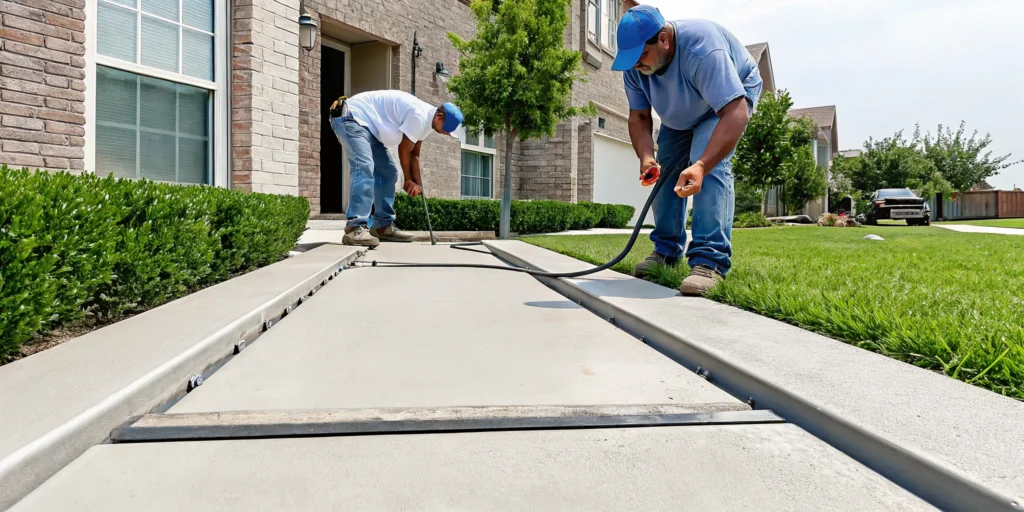
Living in North Texas means dealing with our infamous expansive clay soil. It swells with rain and shrinks in the heat, creating a constant cycle of movement right under your home. This shifting ground is the number one reason why driveways dip, sidewalks crack, and patios become uneven. When you see these signs, you’re not just looking at a cosmetic issue; you’re seeing the direct result of our local geology. Finding a lasting solution requires local expertise. This guide explains why sunken concrete repair in Dallas Fort Worth is different and what you, as a homeowner, need to know to fix the problem for good.
Key Takeaways
- Know the root cause: Sunken concrete in North Texas is usually a result of our expansive clay soil and poor water drainage. Identifying these underlying issues is the first step toward a permanent fix, not just a temporary patch.
- Consider repair before replacement: Lifting your existing concrete with modern methods like polyurethane foam injection is often more cost-effective and less disruptive than a full replacement. This approach addresses the void beneath the slab for a stable, long-term solution.
- Partner with a proven local expert: Choose a licensed and insured company with deep experience in the DFW area. A true professional will offer a clear estimate, have positive customer reviews, and provide a strong warranty that protects your investment against our unique soil conditions.
What Is Sunken Concrete?
You’ve probably seen it before: a driveway that dips in the middle, a patio that’s no longer level, or a sidewalk that has turned into a tripping hazard. That’s sunken concrete. It happens when the soil underneath a concrete slab shifts or erodes, causing the heavy slab to sink and settle unevenly. Here in the Dallas-Fort Worth area, our expansive clay soil is a major factor, as it swells and shrinks dramatically with moisture changes.
When concrete sinks, it’s more than just a cosmetic issue. An uneven driveway can make your home look neglected and lower its curb appeal. More importantly, it creates real safety risks. A raised edge on a walkway can easily cause a fall, and water that pools on a sunken patio can create a slippery mess or even seep toward your home’s foundation. Addressing sunken concrete isn’t just about looks; it’s about maintaining a safe and valuable property. If you’re seeing these issues, it might be time to consider a professional concrete repair.
How to Spot the Warning Signs
Not sure if your concrete is just old or actually sinking? Take a quick walk around your property and keep an eye out for a few tell-tale signs. The most obvious is a surface that is visibly uneven or tilted. You might notice your driveway has a low spot or your pool deck is sloping away from the coping.
Look closer for cracks that seem to be growing or have crumbling edges. This indicates the slab is under stress. After it rains, check for puddles that stick around on your concrete surfaces; this is a clear sign the area is no longer level enough to drain properly. You might also see soil washing out from underneath the edges of your concrete slabs, which means the support system for your concrete is literally disappearing.
Why Acting Fast Saves You Money
It’s easy to put off fixing a small crack or a slightly uneven spot on your patio, but when it comes to concrete, waiting is the most expensive thing you can do. Concrete problems never get better on their own; they only get worse. That small crack will widen, and that slight dip will become a significant sinkhole as the underlying soil continues to erode.
Ignoring the issue doesn’t just lead to a bigger, more expensive repair down the road. It can cause serious secondary problems. Water that pools against your house can lead to costly foundation damage, and a major trip hazard on your property creates a serious liability risk. A quick, simple repair today can save you from a massive headache and a much larger bill tomorrow.
Why Does Concrete Sink in the DFW Area?
Seeing your once-perfect driveway, patio, or sidewalk start to sink and crack can be incredibly frustrating. You might wonder if you did something wrong, but more often than not, the real culprit is right under your feet. Here in the Dallas-Fort Worth area, our unique environment presents some specific challenges for concrete slabs. The ground we build on is constantly shifting, and when you add factors like water, tree roots, and even the original construction quality, you have a perfect recipe for sunken concrete.
Understanding why your concrete is sinking is the first step toward finding a lasting solution. It’s not just about patching a crack; it’s about addressing the root cause to prevent the problem from getting worse. An uneven slab isn’t just an eyesore, it can become a serious trip hazard for your family and guests or lead to more significant structural issues down the road. Let’s walk through the main reasons why concrete sinks in North Texas so you can feel confident about how to fix it for good.
The Trouble with Texas Soil
The biggest challenge for structures in the DFW area is our soil. Much of North Texas is built on expansive clay soil, which acts a bit like a sponge. When it rains, the clay absorbs water and swells up. During our hot, dry summers, it loses that moisture and shrinks. This constant cycle of swelling and shrinking creates movement in the ground beneath your concrete. As the soil shrinks, it can pull away from the underside of the slab, leaving empty spaces or voids. Without solid support, the heavy concrete slab will eventually settle or crack into these voids. This is a primary reason for needing foundation repair in our region.
How Water Runoff Causes Damage
Water is a major factor in soil-related concrete problems. Poor drainage is often a key contributor to sinking slabs. If your gutters are clogged, your downspouts are dumping water right next to your foundation, or your yard slopes toward your house, water can pool and oversaturate the soil in specific areas. This can cause that part of the soil to soften or wash away, a process called erosion. When the soil supporting your concrete erodes, it leaves a void, and the slab above has no choice but to sink. Addressing these drainage issues is a critical part of any effective concrete repair plan to ensure the fix is permanent.
Other Culprits: Tree Roots and Heavy Loads
While soil and water are the main offenders, other factors can also cause your concrete to sink. Large, mature trees are beautiful, but their root systems can be destructive. As tree roots grow, they can push up against a slab from underneath. If the tree is removed or the roots die, they will decompose and leave a void in the soil, causing the concrete to settle. Additionally, your concrete was likely designed for standard residential use. Parking heavy vehicles like an RV, a boat, or a large work truck on your driveway can put more stress on the slab than it was built to handle, causing it to settle over time. You can see examples of these types of fixes in our work.
The Impact of a Poor Foundation Pour
Sometimes, the problem dates back to the day the concrete was first poured. For a concrete slab to remain stable, the ground beneath it must be properly prepared. This involves compacting the soil to create a solid, dense base. If the original contractor cut corners and failed to compact the soil adequately, the loose dirt will naturally settle over time. As the ground settles, the concrete slab sitting on top of it will sink and crack. This is why it’s so important to work with experienced professionals who understand the importance of proper site preparation. A quality job starts with a solid base, a principle our team of experts follows on every project.
Your Guide to Sunken Concrete Repair
Okay, so you’ve spotted a sunken slab. What now? Fortunately, you have a few different options for fixing it. The right choice depends on the extent of the damage, the underlying soil conditions, and your budget. Understanding the pros and cons of each repair method will help you make an informed decision for your home. Let’s walk through the most common solutions, from traditional fixes to modern innovations, so you can see what makes the most sense for your property.
The Traditional Fix: Mudjacking
Mudjacking is one of the oldest tricks in the book for lifting concrete. The process involves pumping a heavy slurry, usually a mix of soil, sand, and cement, through large holes drilled into the slab. This mixture fills the void underneath and forces the concrete back up. While it can be a more budget-friendly option upfront, it has its drawbacks. The material itself is very heavy, which can add more weight to already unstable soil and potentially cause more settling down the road. The process can also be messy, and the larger injection holes are more noticeable after the repair is complete.
The Modern Method: Polyurethane Foam (Polyjacking)
A more advanced and durable solution is polyjacking, which uses high-density polyurethane foam. This method is our preferred approach for professional concrete repair. We drill small, dime-sized holes into the sunken slab and inject a two-part polymer foam. The foam expands, filling every void and gently lifting the concrete back to its original position. It cures in minutes, becoming a rigid, waterproof, and incredibly lightweight material that won’t wash away or add stress to the soil. This makes it a precise, long-lasting fix that is far less invasive and messy than traditional mudjacking, leaving you with a stable surface you can use almost immediately.
Starting Over: Full Concrete Replacement
In some cases, the concrete slab is too cracked, crumbled, or damaged to be saved. When the structural integrity is completely compromised, a full replacement is the only viable option. This involves tearing out the old concrete, preparing the sub-base, and pouring a brand-new slab. As you can imagine, this is the most expensive and disruptive route. It takes more time, creates more mess, and costs significantly more than any repair method. That’s why we always recommend exploring repair options first. Lifting the existing concrete can often save you a substantial amount compared to the cost of a full replacement.
Which Repair Method Is Right for You?
Choosing between mudjacking, polyjacking, and a full replacement comes down to your specific situation. If your concrete is in relatively good shape aside from the sinking, a repair is almost always the smarter choice. Polyjacking offers the best long-term value with its durability and minimal impact. However, the only way to know for sure what your property needs is to have a professional take a look. An expert can assess the underlying soil issues and the condition of the slab to recommend the most effective solution. Don’t wait for the problem to get worse; get a free estimate to understand your options.
What Does Sunken Concrete Repair Cost in DFW?
Let’s talk about the number one question on every homeowner’s mind: what is this going to cost? When you see a sunken driveway or a cracked patio, it’s easy to imagine your bank account draining. But repairing sunken concrete is often more affordable than you might think, especially when you compare it to the cost of a full replacement. The final price tag for your concrete repair project in the Dallas-Fort Worth area isn’t a one-size-fits-all number. It depends on the specific repair method we use, the size and complexity of the job, and a few other key details.
Understanding these elements will help you see what goes into your estimate and why a professional assessment is so important. We believe in transparency, so let’s break down exactly what influences the cost of getting your concrete surfaces back on solid ground. A thorough evaluation allows us to provide an accurate price and a lasting solution, ensuring you don’t face the same problem again in a few years. We also offer straightforward financing options to help make the project manageable for your budget.
How Repair Methods Affect the Price
The technique used to lift your concrete is one of the biggest factors in the overall cost. Traditional mudjacking, which uses a slurry mixture to fill voids, is typically the most budget-friendly option upfront. On the other hand, polyurethane foam injection, or polyjacking, is a more modern method. While it can be more expensive due to the cost of the materials, it’s also lightweight, quick to cure, and requires smaller injection holes. Each method has its place, and the right choice depends on your specific situation and budget. A professional can walk you through the pros and cons to find the best fit for your home.
Key Factors That Influence Your Quote
Beyond the repair method, a few other details will shape your final quote. The sheer size of the area is a major one; a small sunken sidewalk square will cost less than an entire driveway. We also consider the accessibility of the site. If the area is hard to reach with our equipment, it may require more time and labor. Finally, the extent of the problem matters. It’s not just about the square footage, but how deep the void is underneath the slab. This is why an on-site evaluation is essential to provide an accurate price. You can get your free estimate to have one of our experts assess your property.
Repair vs. Replace: The Smarter Financial Choice
When faced with sunken concrete, many homeowners wonder if it’s better to just tear it all out and start over. In most cases, repairing the concrete is a much smarter financial choice. Leveling a sunken slab can save you up to 70% compared to the cost of a full demolition and replacement. Repairing is also faster and far less disruptive to your property and daily life. While some situations with severely cracked or crumbling concrete may require replacement, lifting and stabilizing the existing slab is often the most effective and economical solution. You can see examples of our successful projects by viewing our work.
Understanding Your Concrete Repair Warranty
Think of a warranty as your contractor’s vote of confidence in their own work. After investing in a significant repair, you deserve the peace of mind that comes from knowing the job was done right and is built to last. A warranty isn’t just a piece of paper; it’s a formal promise that protects your home and your wallet from future issues. It shows that a company is willing to stand behind its materials, its process, and its team.
In the Dallas Fort Worth area, where our soil is constantly shifting and settling, a strong warranty is even more critical. It acts as your long-term safety net. A reputable company understands the local challenges and will offer a guarantee that reflects their confidence in providing a lasting solution. Before you sign any contract, it’s essential to have a clear understanding of what the warranty entails, what it covers, and why it’s an absolute must-have for any concrete repair project in North Texas. We believe so strongly in our methods that we proudly showcase our work for all to see.
What a Good Warranty Should Cover
Not all warranties are created equal, so it’s important to read the fine print. For major structural work, like slab repairs, the best companies often provide a lifetime transferable warranty. This means the repair is guaranteed for the life of your home, and that guarantee can be passed on to the next owner, which is a fantastic selling point. This type of warranty signals that a company uses high-quality materials and proven methods.
For other types of jobs, you might see warranties covering workmanship for a specific period, often between one and five years. The most important thing is that the warranty is in writing and clearly spells out what is covered and what is not. Ask questions like: Does it cover materials and labor? Is it transferable? What are the conditions or exclusions? A clear, comprehensive warranty is the hallmark of a professional and trustworthy contractor.
Why Warranties Are Non-Negotiable in DFW
As we’ve discussed, the expansive clay soil in the DFW area is a primary cause of concrete and foundation problems. This soil swells when it’s wet and shrinks dramatically when it’s dry, putting constant stress on the structures above. A concrete repair can fix the immediate damage, but a warranty is what protects you from future movement. It’s your assurance that the repair was designed to withstand our region’s unique geological challenges.
A company that offers a weak warranty, or no warranty at all, may not be confident that its solution will hold up over time. A strong, long-term warranty is a non-negotiable part of the deal. It demonstrates that the company has faith in its repair methods and is committed to your long-term satisfaction. You can learn more about a company’s dedication to quality and customer service by reading into their history and mission, which is why we share the story of who we are on our about page.
How to Choose the Right DFW Concrete Repair Company
Finding the right team to fix your concrete can feel like a big decision, because it is. You’re not just hiring someone to patch a crack; you’re trusting them to protect one of your biggest investments. The wrong choice can lead to shoddy work that fails in a year or two, leaving you back where you started but with less money in your pocket. The good news is that a little homework goes a long way in finding a reliable partner. When you know what to look for, you can confidently choose a company that will do the job right the first time.
A great concrete repair company will be transparent, experienced, and professional from the first phone call to the final handshake. They should be able to explain the problem and their proposed solution in a way that makes sense to you, without relying on confusing technical jargon. It comes down to a few key steps: checking their background and local expertise, seeing what other customers have to say, and understanding the details of their estimate. By focusing on these areas, you can filter out the unreliable options and find a true professional who stands behind their work. This process helps ensure the concrete repair is a lasting solution, not a temporary fix.
Verify Their Credentials and Local Experience
First things first, make sure any company you consider is properly licensed and insured. This is a non-negotiable step that protects you from liability if something goes wrong on your property. A professional contractor will have these credentials readily available. Beyond the basics, look for a company with deep roots in the Dallas Fort Worth area. Given our region’s tricky clay soil, you want a team that understands local conditions inside and out. An experienced local company will know exactly how to create repairs that can withstand the seasonal shifts unique to North Texas, ensuring your investment lasts for years to come.
Look at Reviews, Estimates, and Payment Options
Customer reviews are your window into a company’s track record. Look for patterns in feedback to see how they handle communication, timeliness, and the quality of their work. While a few negative reviews aren’t always a dealbreaker, a consistent theme of unhappy customers is a major red flag. Next, get at least two to three detailed estimates. This isn’t just about finding the lowest price; it’s about comparing the proposed solutions. A trustworthy company will provide a clear, itemized quote. Finally, don’t be afraid to ask about payment. Many reputable companies offer flexible financing options to make the project more manageable for your budget.
Partner with DFW’s Concrete Repair Experts
When you notice sunken concrete, choosing the right team to fix it is the most important decision you’ll make. You need a local partner who not only understands the technical side of concrete repair but also gets the unique challenges of our Texas soil. At Solid Base, we’re not just contractors; we’re your neighbors. We’ve built our reputation on solving structural problems for homeowners across the Dallas-Fort Worth area with honesty and expertise. Our team brings years of hands-on experience to every project, ensuring we get the job done right the first time.
We combine our deep local knowledge with the strength of patented, proven products. This means you get a solution that is specifically designed to last in our region’s demanding environment. We believe in clear communication and transparent practices from start to finish. You can learn more about our commitment to quality and customer satisfaction by getting to know the team at Solid Base. We’re here to provide a permanent solution, giving you the peace of mind that your home is resting on a solid, stable base for years to come.
See Our Proven Repair Process
We know that the thought of a major repair can be stressful, so we make our process as straightforward and non-invasive as possible. For most sunken concrete issues, we use an advanced method called polyurethane foam injection, or polyjacking. This technique involves injecting a structural-grade polymer foam into small holes drilled through the sunken slab. The foam expands, lifting the concrete back to its original position and stabilizing the soil beneath it. It’s a fast, clean, and incredibly effective way to handle concrete repair. You can see the results for yourself by looking at some of our work for other DFW homeowners.
Proudly Serving the Greater Dallas Area
As a local company, we are dedicated to serving the communities where we live and work. Our team is proud to provide reliable concrete and foundation repair services throughout the Dallas-Fort Worth metroplex. Whether you’re in Dallas, Denton, Lewisville, Plano, or Allen, you can count on us for professional and timely service. We understand the specific soil conditions and building practices in North Texas, which allows us to diagnose problems accurately and recommend the most effective solutions. You can check our full service area to see if we cover your neighborhood. We’re committed to helping our fellow Texans protect their most valuable asset: their home.
Get Your Free, No-Obligation Estimate
Ignoring sunken concrete won’t make it go away; in fact, the problem will likely get worse and more expensive to fix over time. The best first step you can take is to understand the extent of the issue. We make that easy by offering a free, no-obligation estimate. One of our experts will visit your property, assess the damage, and explain your repair options clearly, so you can make an informed decision without any pressure. We also offer flexible financing options to help make your repair manageable. Contact us today to schedule your free inspection and take the first step toward a lasting solution.
Related Articles
- Concrete Repair – Solid Base
- Polyurethane Slab Jacking: A Homeowner’s Guide
- Ultimate Guide to Foundation Repair Options
- How to Fill Large Cracks in Concrete Like a Pro
- Foundation Repair – Solid Base
Frequently Asked Questions
My concrete only has a small crack. Do I really need to fix it now? It’s tempting to ignore a small crack, but it’s often the first sign of a bigger problem. That crack indicates the ground underneath is no longer providing stable support, causing the concrete slab to bend and stress. If left alone, water can seep into the crack, wash away more soil, and cause the slab to sink further. Addressing it early is a simple repair that prevents it from becoming a large, hazardous, and much more expensive issue down the road.
How do I know if my concrete can be lifted or if it needs to be completely replaced? The great news is that most sunken concrete can be lifted and saved. If your slab is still in one solid piece, even with some cracks, polyjacking can effectively lift it back into place. A full replacement is usually only necessary when the concrete is completely shattered, crumbled, or broken into many small, unsalvageable pieces. The best way to know for sure is to have a professional assess the structural integrity of the slab.
How long does a typical polyjacking repair take? Polyjacking is a surprisingly fast process. For most residential projects like driveways, patios, or sidewalks, the work can be completed in just a few hours. The polyurethane foam we use cures very quickly, becoming solid and stable within about 15 to 30 minutes. This means you can typically walk on the repaired surface almost immediately and drive on it the same day.
Is polyjacking a permanent solution for our shifting Texas soil? Yes, it is designed to be a durable, long-term solution. The high-density polyurethane foam we use is a structural-grade material that is waterproof and inert, so it won’t wash away or break down in the soil. By filling the voids and stabilizing the ground directly beneath the slab, it creates a strong, solid base that resists the effects of our expansive clay soil, providing a lasting fix.
What happens during a free estimate? When you schedule a free estimate, one of our specialists will come to your home at a time that works for you. They will perform a thorough inspection of the sunken concrete, identify the underlying cause of the problem, and walk you through the most effective repair options. We’ll answer all your questions and provide a clear, detailed quote in writing, so you have all the information you need to make a decision with no pressure or obligation.